How Fast Can Animals Really Go? The Science of Speed
What makes the fastest animals so fast and how do they compare?
On this page
Speed Isn't One Thing: How We Actually Measure It
Here's the twist that breaks every "fastest animal" list: a tiny mite can be "faster" than a cheetah. It all depends on what you mean by fast.
When scientists talk about speed, they're usually measuring one of three very different superpowers:
- Top speed — the highest velocity an animal can hit, even for a split second.
- Sustained speed — how fast it can keep moving over a long distance (cheetahs are sprinters, not marathoners).
- Acceleration — how quickly it reaches that speed from a standstill, which is often what catches prey.
Mixing these up is how you get unfair fights. A peregrine falcon hits around 240 mph (386 km/h), but only in a dive (a steep, gravity-assisted plunge called a "stoop"). That's not running power — it's basically a controlled fall. Comparing it to a cheetah's roughly 60–70 mph (97–113 km/h) flat-out sprint is like racing a skydiver against a sprinter.
There's an even fairer ruler: body lengths per second, which measures how many of its own body lengths an animal covers each second. By that math, a Southern Californian mite clocks about 322 body lengths per second — the cheetah manages around 16. Pound for pound, the speck wins.
And the rules change with the medium. Moving through air, land, and water each comes with totally different drag, gravity, and grip — so a champion in one arena would flounder in another. Keep these distinctions in mind, and the rest of the numbers will actually make sense.
Champions of the Sky: Why Birds Rule Raw Speed
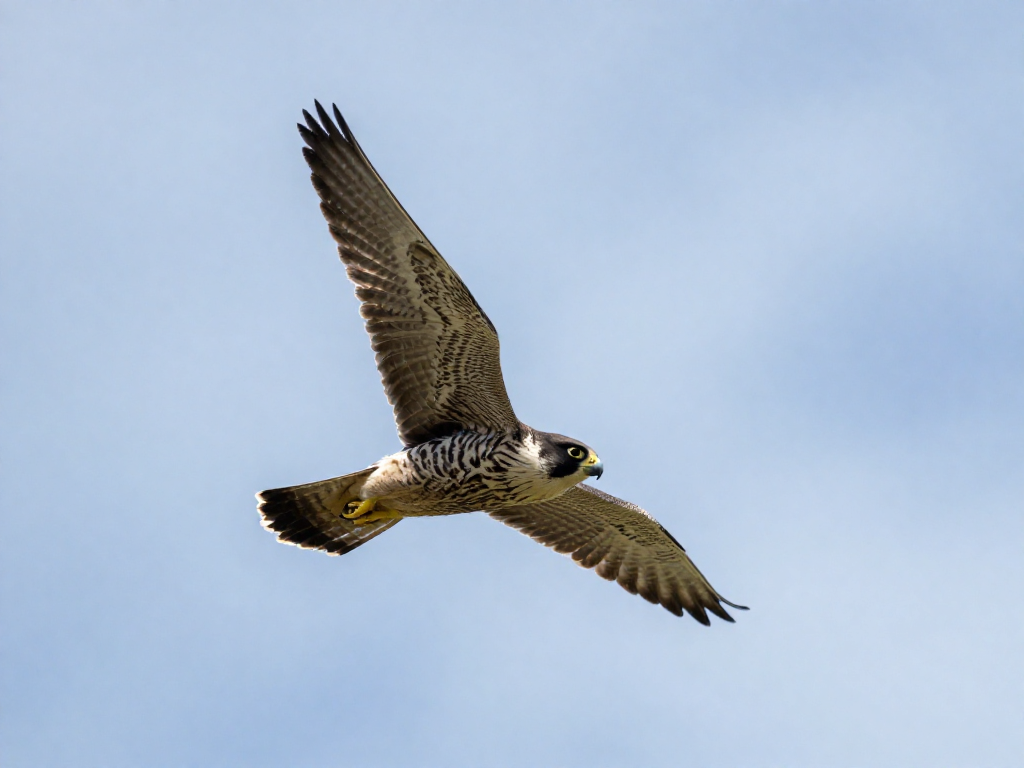
The peregrine falcon can hit 240+ mph in a dive—faster than a Formula 1 car at top speed. That makes it the fastest animal on Earth, and it pulls off this stunt partly by cheating: gravity does much of the work.
The Dive That Breaks Records
When a peregrine spots prey below, it folds into a stoop (a steep, high-speed dive) and lets gravity accelerate it like a falling stone. But falling isn't enough—the bird has to survive it. Its body is shaped like a teardrop, with wings tucked tight to slash air resistance. Most remarkable are tiny cone-shaped bumps inside its nostrils (called baffles) that scientists believe slow the rushing air so the falcon can still breathe at speeds that would otherwise overwhelm its lungs. Special clear inner eyelids wipe and protect its eyes mid-plunge.
Dive Champs vs. Level-Flight Champs
Diving and flying flat are two different contests. Strip away gravity's boost and the rankings shuffle:
- Fastest dive: Peregrine falcon, ~240+ mph
- Fastest level flapping flight: Common swift, around 69 mph
- Honorable mention: White-throated needletail, often cited near 100 mph in flapping flight (figures vary by study)
So the peregrine "wins" thanks to physics, while swifts are the true endurance speedsters of powered flight.
Built for Speed
Birds are engineered for it from the inside out. Their bones are hollow yet braced with internal struts—lightweight but strong. Oversized chest muscles (the "drumstick" of the breast) power each wingbeat. And their lungs are unusually efficient, pulling fresh oxygen on both the inhale and the exhale, fueling muscles that ground-bound animals simply can't match.
Raw speed, it turns out, is a full-body design problem—and birds solved it brilliantly.
Kings of the Land: The Cheetah and Its Rivals
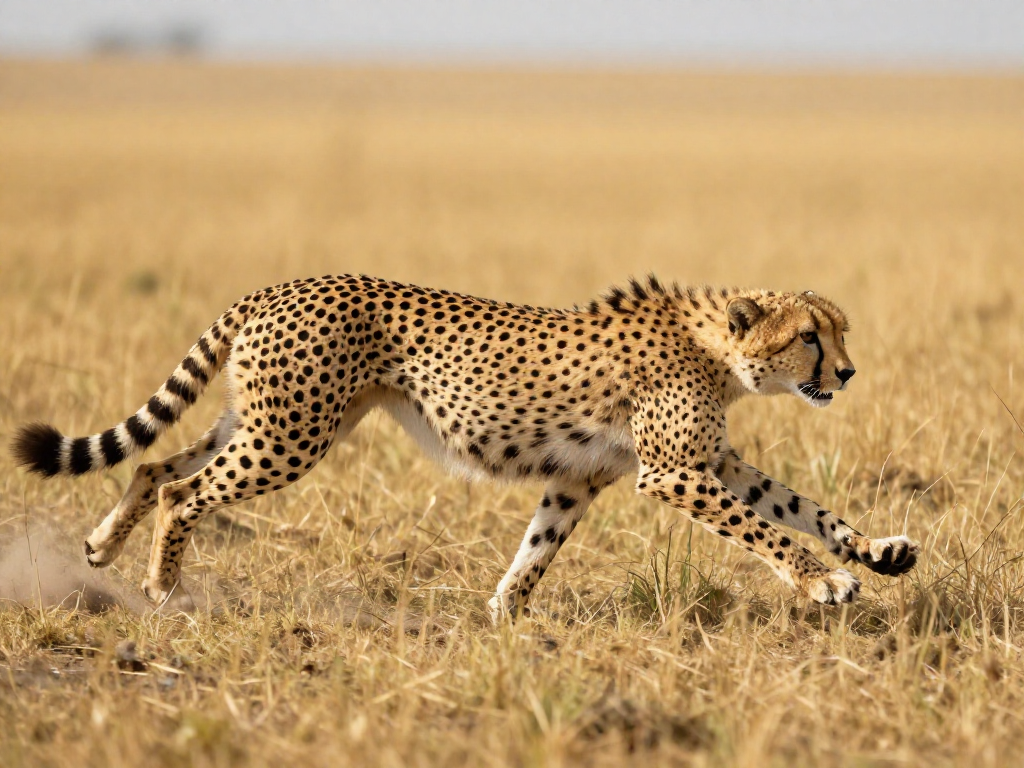
Imagine going from zero to highway speed faster than most sports cars. The cheetah does exactly that, hitting 60–70 mph in just a few seconds—making it the fastest land animal on Earth.
So how does a cat outrun a Ferrari off the line? It's all in the body design.
- A spine that works like a spring. A cheetah's backbone is incredibly flexible, coiling and uncoiling with every bound. This catapult action stretches each stride to around 20–25 feet, so the cat is airborne more than it's touching ground.
- Built-in cleats. Unlike most cats, cheetahs have semi-retractable claws (claws that don't fully tuck away), giving them constant grip—like a sprinter's spikes digging into the track.
- A tail that steers. That long, heavy tail acts as a rudder, swinging to balance sharp, high-speed turns when chasing zig-zagging prey.
But there's a catch: this all-out sprint is brutally expensive. A cheetah's body temperature spikes so fast that it can only run flat-out for about 20–30 seconds before overheating forces it to stop. Most chases are won or lost in seconds—or not at all.
The Marathon Runner: Pronghorn Antelope
Speed isn't only about the sprint. Meet North America's pronghorn antelope, which can run roughly 55 mph and, more impressively, hold a fast pace for miles. With oversized lungs and a heart built for endurance, it can cruise where a cheetah would collapse.
Scientists think the pronghorn evolved this incredible stamina to escape the American cheetah, a predator that went extinct over 10,000 years ago. In other words, today's pronghorn is still outrunning a ghost.
Speed Demons of the Sea: Built to Cut Through Water
Imagine sprinting through a substance roughly 800 times denser than air—then doing it at highway speeds. That's the everyday reality for the ocean's fastest swimmers, and it's why their speed records are arguably more jaw-dropping than any cheetah's dash.
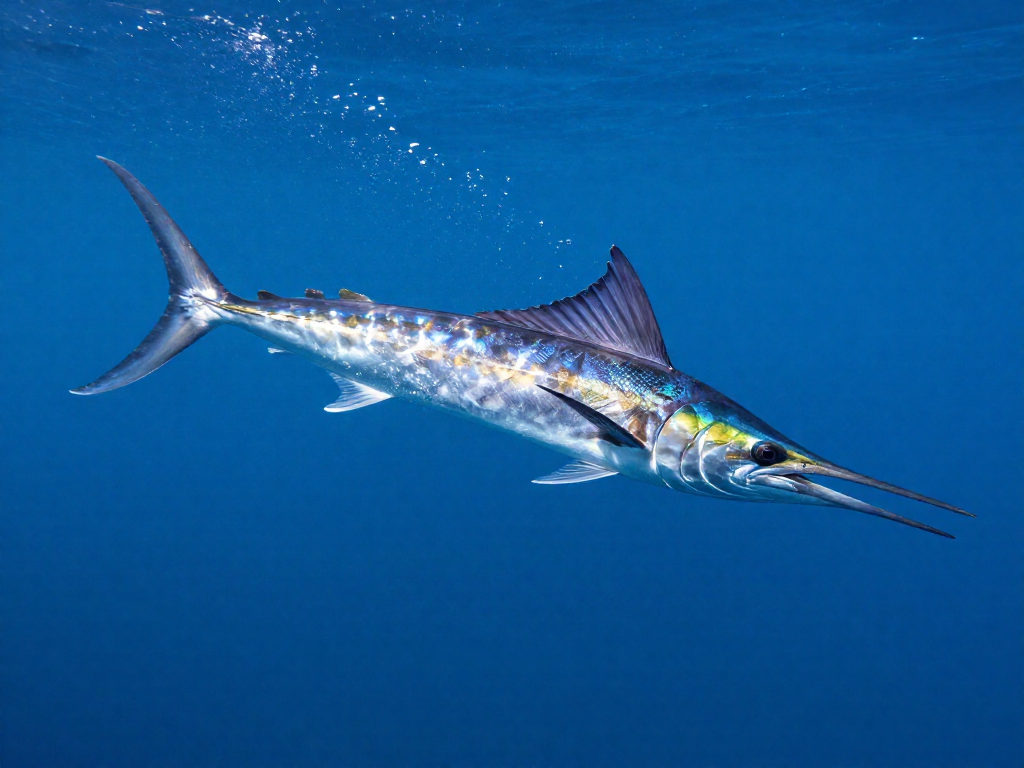
The sailfish and black marlin top most "fastest fish" lists, with frequently cited estimates around 50–68 mph. But here's the honest part: those numbers are hotly debated. Many older claims came from indirect methods, like timing how fast line peeled off a fishing reel. More careful studies suggest top bursts are likely lower than the flashiest figures—still blisteringly fast, just harder to pin down.
Why is moving through water such a big deal? Drag (the resistance a fluid pushes back with as you move through it) skyrockets in dense water. To win that fight, fast fish evolved a toolkit:
- Torpedo-shaped bodies that slip through water with minimal turbulence.
- Powerful crescent-shaped tails that snap side to side for explosive propulsion.
- Drag-reducing surfaces, including mucus and fine scale structures that help water flow smoothly along the body.
- Retractable fins that tuck away during high-speed bursts to stay streamlined.
Measuring all this is genuinely tricky. Scientists now use high-speed video, accelerometer tags, and lab flow studies instead of reel-timing guesses—which is exactly why old "record" numbers keep getting revised. The takeaway: these fish are extraordinary athletes, even when the exact mph carries an asterisk.
The Physics of Going Fast: What All Speedsters Share
Whether it slices through air, sand, or seawater, every record-breaker on Earth is fighting the same invisible opponent: drag. That shared battle is why a peregrine falcon, a cheetah, and a sailfish — three animals that look nothing alike — end up with strangely similar design tricks.
Drag is the universal enemy. Drag (the resistance a body feels pushing through air or water) grows fast as you speed up, so nature's champions are obsessively streamlined. Falcons tuck into a teardrop dive, cheetahs flatten their bodies, and sailfish fold their fins into grooves to shrink their surface area and slip through with less friction.
Power-to-weight ratio decides the rest. Speed isn't just muscle — it's muscle per pound. Fast animals are packed with fast-twitch fibers (muscle built for short, explosive bursts rather than endurance), giving them a high power-to-weight ratio. That's why a lean cheetah out-accelerates a far stronger lion.
Bigger isn't always faster. Size cuts both ways: too small and you can't generate enough power; too big and you're hauling extra weight and drag. Mid-sized, lightweight builds tend to win sprints, while bulk helps mainly with momentum once you're already moving.
The trade-off triangle. No animal maxes out everything. Speed, endurance, and maneuverability pull against each other — the cheetah's blazing sprint lasts only seconds, while slower animals trade top speed for stamina or sharp turns.
Surprising Speed Record-Holders You Didn't Expect
Forget the cheetah for a second: the real speed champion might be a mite the size of a sesame seed. The Southern California mite Paratarsotomus macropalpis can scramble 322 body lengths per second. Scaled up to human size, that's like sprinting around 1,300 mph — faster than the speed of sound.
Here are a few more pocket-sized record-breakers worth sharing:
- Mantis shrimp strike: Its club-like claw lashes out at roughly 50 mph underwater — among the fastest movements ever recorded in any animal, and quick enough to boil tiny bubbles around it.
- Trap-jaw ant snap: Its jaws slam shut at up to 140 mph (about 64 m/s), one of the fastest self-powered moves in the animal kingdom — it can even fling itself into the air.
- Fastest true flier: Among insects flapping under their own power, dragonflies and certain horseflies clock in around 30+ mph.
How do you stack up? A casual bike ride (about 12 mph) would leave a sprinting house cat (roughly 30 mph) in the dust only if it slowed down — but you'd cruise right past a running chicken (about 9 mph).
Sources: Journal of Experimental Biology; University of California research on Paratarsotomus macropalpis.
The Speed Leaderboard: Air vs. Land vs. Water
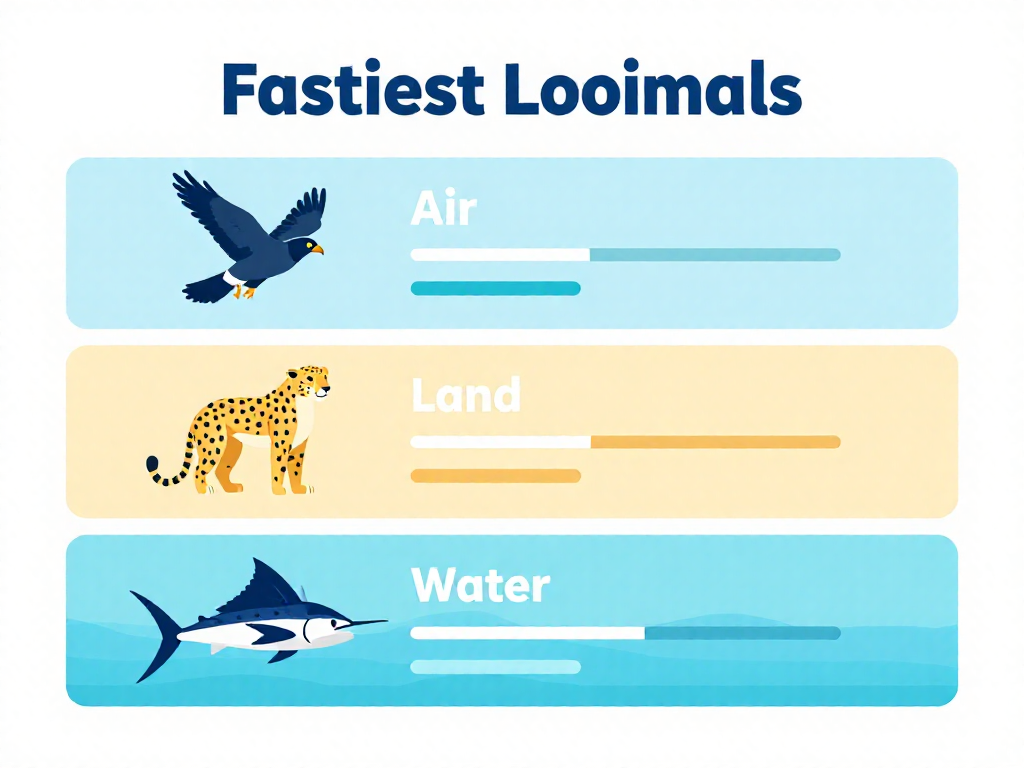
The undisputed champion isn't on the ground at all — it's a bird falling out of the sky. Here's how the top speeds stack up across all three domains:
| Animal | Domain | Top Speed |
|---|---|---|
| Peregrine falcon (dive) | Air | ~240 mph |
| White-throated needletail (level flight) | Air | ~69 mph |
| Cheetah (sprint) | Land | ~70 mph |
| Pronghorn (sustained) | Land | ~55 mph for miles |
| Sailfish | Water | ~50–68 mph (debated) |
| Human (cycling) | Land | ~45 mph (downhill record far higher) |
| Human (running) | Land | ~27 mph (Usain Bolt, peak) |
| Human (swimming) | Water | ~6 mph |
Burst vs. sustained matters: the cheetah's 70 mph lasts only ~20–30 seconds, while the pronghorn cruises at 55 mph for miles — making it the true endurance king.
The takeaway: "fastest" depends entirely on how you measure. A peregrine wins a dive, a needletail wins flapping flight, and a pronghorn wins the marathon.
See also
- Other Animal Superpowers explainers (strongest, longest-living, deadliest animals)
- How animals survive extreme environments
- Cheetah facts deep-dive article
- Peregrine falcon or birds of prey explainer
- Mantis shrimp facts article
Related articles
How Do Spiders Make Silk? The Chemistry Behind Nature's Strongest Fiber
How do spiders produce silk, and what makes it so strong?
Jul 28, 2026 · 10 min read
How Electric Eels Generate Shocks: A Deep Dive into Nature’s Living Batteries
How do electric eels produce electricity?
Jul 28, 2026 · 10 min read
Why Don't Woodpeckers Get Headaches? The Built-In Shock Absorbers
How do woodpeckers avoid brain injury despite repeated hammering?
Jul 20, 2026 · 6 min read