Monogamy vs. Polygamy in the Animal Kingdom: A Comparative Guide
How do monogamous and polygamous mating systems compare, and which animals use which?
On this page
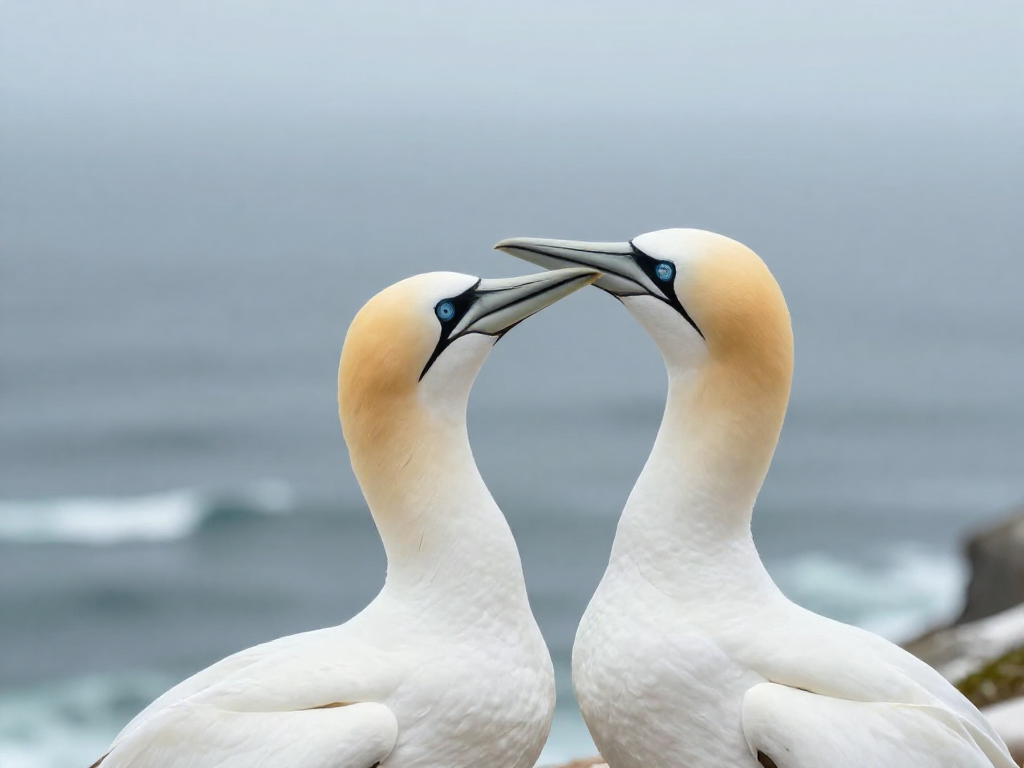
We romanticize 'mating for life,' but the animal kingdom has a far more complex story. From swans to seahorses, what you see isn't always what you get. This guide compares monogamy and polygamy across species, revealing the surprising science behind pair bonds and harems.
Mating Systems 101: Defining Monogamy, Polygamy, and More
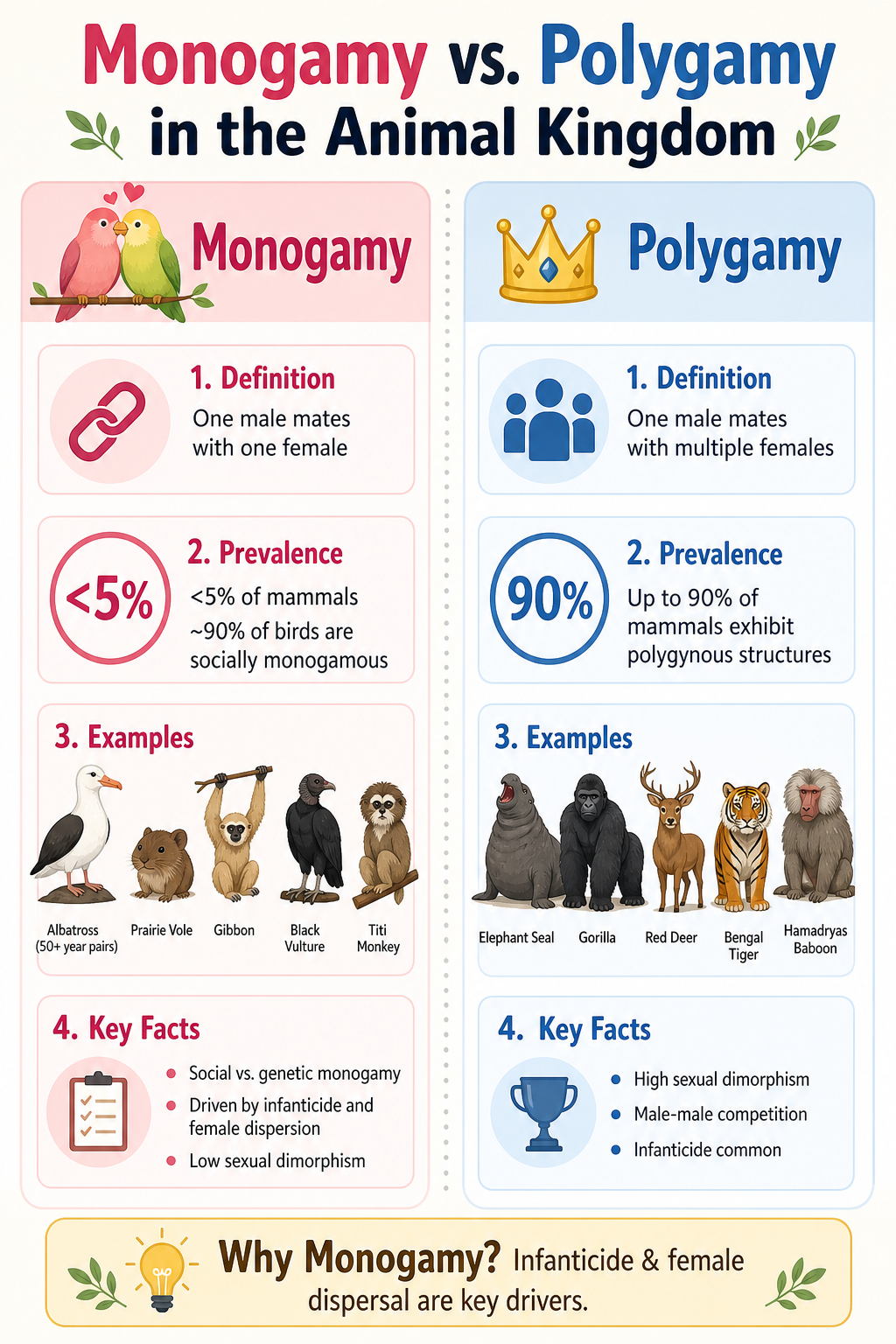
Monogamy and polygamy aren’t just about partner counts—they’re survival strategies shaping parenting and territory. Social monogamy, where a pair shares a home and childcare, is common (about 90% of bird species form such bonds, per Wikipedia), but genetic monogamy is rare; DNA often reveals chicks from other fathers. Polygamy branches into polygyny (one male, several females), seen in gorillas and elephant seals; polyandry (one female, several males); polygynandry (both sexes have multiple partners); and promiscuity, where no lasting bonds form.
The Surprising Rarity of True Monogamy in Mammals (and Its Abundance in Birds)
If you picture monogamous animals, you might imagine devoted wolf packs or cozy prairie voles. But here’s the wild truth: monogamy is a rare gem among mammals. Only 3–9% of mammal species practice any form of social monogamy—meaning they form a pair bond and share parenting duties. That’s it. Out of roughly 6,500 mammal species, the vast majority are polygamous in some way. Birds? That’s a completely different story. A staggering 90% of bird species are socially monogamous, at least for a breeding season. So why the dramatic split? And does “socially monogamous” really mean faithful? Not exactly.
Most bird pairs that raise chicks together aren’t strictly faithful. Genetic testing has revealed a fascinating secret: extra-pair paternity is remarkably common. Eastern bluebirds are a perfect example. In one study, at least 5% of male bluebirds and 15% of female bluebirds were caring for chicks that weren’t their genetic offspring, according to a review in Frontiers in Ecology and Evolution. So while they put on a united front, a significant number of birds are raising someone else’s kids. This happens across many supposedly “monogamous” species. Even penguins, the poster birds for loyalty, have re-pairing rates that vary: Adélie penguins stay together about 62% of the time the next season, while chinstrap penguins manage 82%. That means a fair number of penguins are swiping left on their old mates.
The few truly monogamous mammals often show a tighter genetic link. For instance, Eurasian beavers are both socially and genetically monogamous—they mate for life and the DNA checks out. Their North American cousins, however, are only socially monogamous, meaning they pair up but sometimes sneak around. Among primates, about 29% are socially monogamous, a higher rate than mammals overall. But the only apes that form long-term monogamous bonds? Gibbons. These small, swinging apes sing duets and fiercely guard their territory together, and genetic tests confirm they’re as faithful as they seem. Not all monogamy is created equal. The scarlet macaw provides a mind-bending twist: they are genetically monogamous (no extra-pair chicks found) but socially they flock together at night for safety, so they aren’t strictly pairing off socially. It’s a reminder that nature rarely fits our tidy human labels.
So next time you see a pair of lovebirds—or love mammals—remember that “monogamy” in the wild is often a spectrum. What looks like devotion might be a parenting strategy, and what seems like a lifelong romance might be a seasonal arrangement. From the truly faithful Eurasian beaver to the socially flexible scarlet macaw, the animal kingdom keeps us guessing. Perhaps the real surprise isn’t that monogamy is rare in mammals—it’s that it exists at all, and that birds, despite their 90% rate, have their own hidden complexities.
Why Pair Up? The Evolutionary Drivers of Monogamy
Why would an animal stick with just one mate? For a long time, the answer seemed simple: two parents are better than one at raising helpless young. But when scientists looked across thousands of mammal species, they discovered a much darker and more surprising driver: male infanticide. In many species, unrelated males will kill young that they haven't fathered to bring females back into breeding condition. Against that backdrop, monogamy becomes a survival strategy — a way for males to guard against the loss of their own offspring. In primates alone, infanticide rates can reach a staggering 63 percent in some species. A landmark 2013 study that analyzed the evolutionary history of 230 primate species found that high infanticide rates consistently preceded the switch to social monogamy, shattering the older idea that males stayed home just to help with parenting.
Not everyone agrees that infanticide is the whole story. A competing hypothesis, tested in a meta-analysis of over 2,000 mammal species, points to female dispersion. When females are forced to spread out across a landscape to avoid competing for food, no single male can guard or win access to more than one at a time. Monogamy, in this view, emerges simply because polygamy becomes logistically impossible. The science is far from settled, but the upshot is clear: pair bonding can be driven by very different pressures depending on the species.
Beneath these evolutionary forces lies a biochemical switch. In a striking experiment, researchers boosted oxytocin and vasopressin receptors in the brains of promiscuous meadow voles — animals that normally mate with multiple partners and show zero long-term attachment. The result? The once-freewheeling voles suddenly favored a single partner and behaved just like their famously loyal relatives, the prairie voles (WHYY). The same hormone-receptor systems prime the human brain for bonding, but in voles, tweaking just those receptors was enough to flip the mating system on its head.
You can often spot a monogamous mammal from across a field — or fail to tell male from female. When males stop battling each other for harems, the evolutionary pressure for showy weapons and larger bodies evaporates. Many monogamous primates, for instance, are virtually identical in size, shape, and color. This lack of sexual dimorphism is a quiet anatomical signature of a life where pair bonds matter more than brute force.
Polygyny: When One Male Rules Many Females
If you're looking for the mammal world's most common love life, you'll find it in polygyny — a system where one male mates with multiple females, while other males are left out in the cold. Polygyny shows up in everything from tiny house wrens to gigantic elephant seals, and it takes several distinct forms.
In some species, a male defends a patch of land rich in food or nesting sites, and females come to him (resource defense). Red deer and Bengal tigers operate this way, with males controlling large territories that overlap with the ranges of several females. Hamadryas baboons go a step further: males actively herd and guard a small harem of females, a strategy known as female defense. On display grounds called leks, males gather to perform elaborate dances or calls, and females pick the most impressive show-off — common pheasants and red-winged prinias do this, and the alpha male ends up mating with most of the visitors.
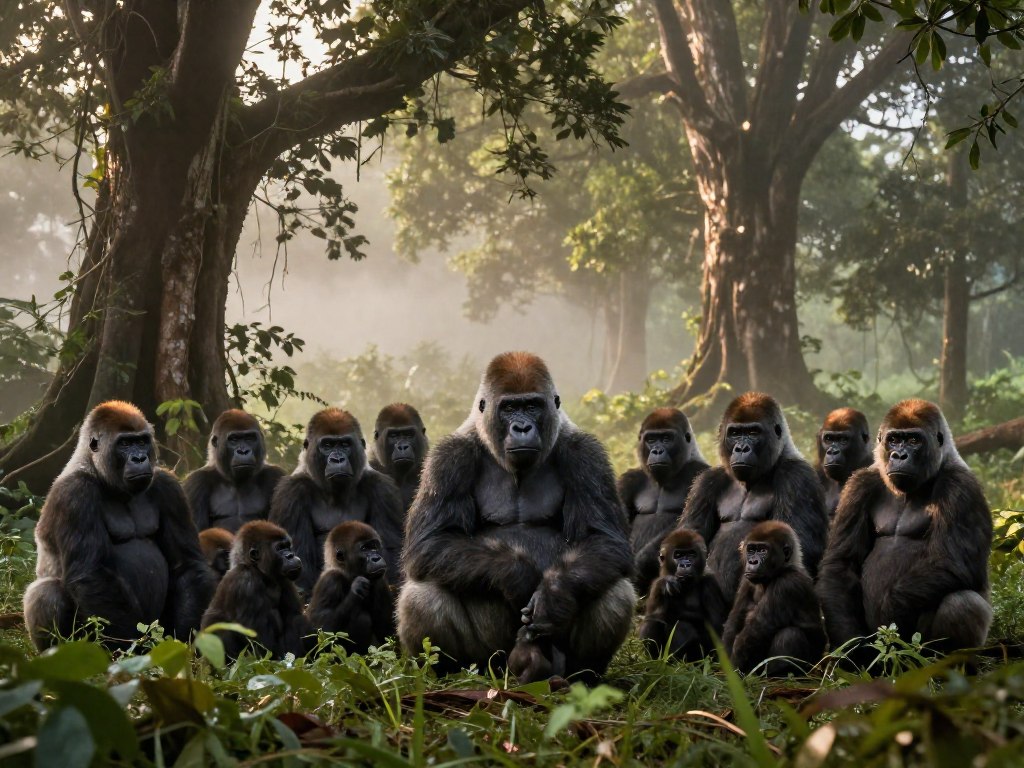
The competition for females often leads to dramatic physical extremes. Male elephant seals, for instance, can be many times larger than females — a classic sign of strong male-male combat. But it's not just about size; after mating, the real battle happens at the microscopic level. In chimpanzee troops, a female in heat may mate with eight different males in under an hour, turning the fight into a sperm competition. This favors males with enormous testicles and exceptionally high sperm counts (WHYY). The silverback gorilla, meanwhile, takes the more straightforward route: he uses his intimidating bulk to keep rival males away from his harem of females.
Polygyny isn't a single strategy but a whole playbook of ways to dominate the mating game, each shaped by habitat, food, and social life. From the thunderous challenges of elephant seals on a beach to the quiet biological arms race inside a chimp's body, it's nature's favorite — and most unequal — way of passing on genes.
Monogamy vs. Polygyny: A Battle of Ecological Pressures
Walk through a spring forest and you'll see paired songbirds everywhere—monogamy is the norm for birds, with an estimated 90% of species forming pair bonds. For mammals, it's the opposite: only 3–9% of species are monogamous. The reason is brutally practical. Birds rely on biparental care; incubating eggs and stuffing hungry chicks with insects demands two adults. In mammals, pregnancy and lactation load the whole job onto the female. Males often contribute little beyond their genes, so polygyny prevails.
Resource distribution then decides who gets to be monogamous. When food is clumped in rich patches, females naturally gather, and a dominant male can defend a whole harem—classic polygyny at its most extreme. Think of an elephant seal, a gorilla, or a Bengal tiger. When resources are spread thin and evenly, females disperse. A male can only monopolize one, and social monogamy emerges.
Two vole species living side by side in North America illustrate this perfectly. Prairie voles forage in dense, predictable grasslands; a mated pair successfully defends a territory and raises pups together. Meadow voles, in contrast, drift across scattered, unpredictable food patches. Females rarely stay put, so males simply mate with whoever is nearby. Neurobiology even underpins the split: when researchers gave meadow voles the oxytocin and vasopressin receptors of prairie voles, the promiscuous voles formed pair bonds—an experiment that directly flipped the switch to monogamy (WHYY).
Predation danger adds another layer. When a nest needs two defenders, monogamy gets a boost. Both bluebird parents, for instance, tirelessly feed and guard their chicks—but even here, genetics reveal cracks in the arrangement. At least 15% of female and 5% of male eastern bluebirds care for at least one offspring that isn't genetically theirs. Social monogamy often masks extra-pair liaisons.
For primates, the biggest pressure may be something darker. A landmark study of 230 primate species found that male infanticide, not biparental care, likely drove the evolution of social monogamy. When a male sticks around to protect his offspring, rival males are less likely to kill them. Infanticide rates in some primates can reach 63%, making a full-time bodyguard a life-or-death advantage.
The Gap Between Social and Genetic Reality: Infidelity in the Wild
Socially monogamous animals often don’t live up to the fairy-tale ideal of lifelong fidelity. Under the surface of many committed pairs is a surprising amount of what scientists delicately call “extra-pair copulations.” In other words, cheating is common—even in species famous for sticking together.
Take eastern bluebirds, those picture-perfect couples often held up as symbols of devotion. Genetic testing reveals that at least 5% of male and 15% of female bluebirds are raising chicks that are not biologically their own. This genetic infidelity is widespread: while about 90% of bird species form social pairs, most practice only social, not genetic, monogamy.
Some animals, however, take a harder line on unfaithfulness. Black vultures are strictly socially monogamous and have been known to enforce that standard with surprising harshness. If a black vulture is caught cheating, it can face punishment from the rest of the flock—sometimes including aggressive pecking or exclusion (MyFahlo). This kind of social enforcement keeps the pair bond ironclad.
The relationship between social and genetic monogamy isn’t always straightforward. Seahorses flip the script: research suggests they practice genetic monogamy (pairs sire all their offspring together) but live in social groups that practice polyamory—meaning they don’t pair off into exclusive living arrangements. In the end, truly faithful hearts are rare across the animal kingdom, and even the most loyal-looking couples might have secrets.
Beyond the Usual Suspects: Monogamy in Fish, Frogs, and Lizards
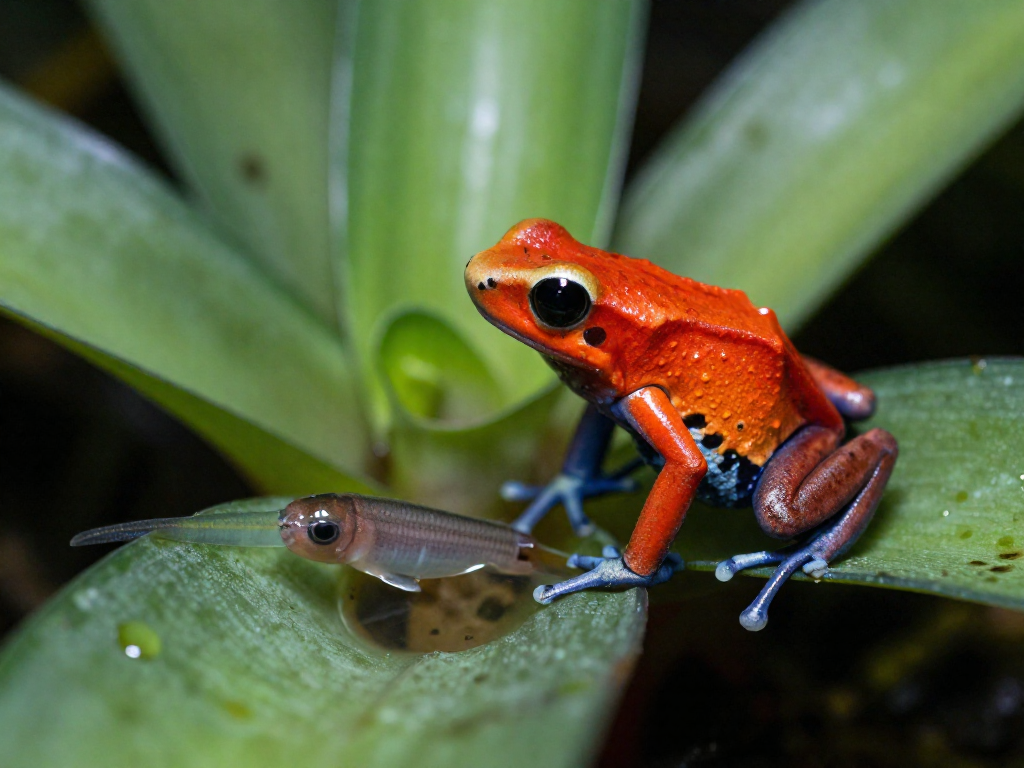
Monogamy is quite rare in fish and amphibians, but a handful of species break the mold. The mimic poison frog (Ranitomeya imitator) shattered expectations as the first amphibian known to be both socially and genetically monogamous (Frontiers). In the ocean, bonnethead sharks usually practice within-litter genetic monogamy, though about 19% of litters have multiple fathers. And on land, shingleback lizards form short-term bonds that are socially and genetically faithful—a rare sight among reptiles. These oddballs prove that even in groups where monogamy seems improbable, nature has a few surprises.
Sources
- 10 examples of monogamy in the animal kingdom — crosstalk.cell.com
- Monogamy in animals - Wikipedia — en.wikipedia.org
- 18 Animals That are 100% Monogamous — a-z-animals.com
- Social monogamy in mammalian species - Wikipedia — en.wikipedia.org
- Animals That Stay Together Forever 🦢💑 | Monogamous Animal Pairs — youtube.com
- Why Some Animals Are Monogamous – but not Higgs the cat. - WHYY — whyy.org
- Frontiers | Why Monogamy? A Review of Potential Ultimate Drivers — frontiersin.org
- Polygyny in animals - Wikipedia — en.wikipedia.org
- 6 Animals that Mate for Life - The National Wildlife Federation Blog — blog.nwf.org
- Animals That Mate for Life: Valentine’s Day in the Wild | The Great Projects — thegreatprojects.com
- 9 Animals That Mate for Life: Monogamous Animals List! — myfahlo.com
See also
- 10 Animals That Mate for Life (and One That Definitely Doesn’t)
- Why Prairie Voles Hold the Key to Love
- The 5 Most Dramatic Mating Battles in the Animal Kingdom
- How Animals Choose Their Mates: A Beginner’s Guide
- The Strangest Parenting Roles in the Wild
Related articles

When Your Dog Won't Stop Licking: A Troubleshooting Guide for Common Causes
Why does my dog keep licking everything, and how can I address it?
Jul 28, 2026 · 7 min read
Why Do Birds Sing at Dawn? The Science of the Dawn Chorus
Why do birds sing so loudly early in the morning?
Jul 28, 2026 · 6 min read

Pack Hunters vs. Ambush Predators: Which Hunting Strategy Is Better?
How do pack hunting and ambush hunting compare in the animal kingdom? We break down success rates, energy costs, and surprising strategies to reveal which approach truly dominates.
Jul 20, 2026 · 6 min read