Rainforest Animals 101: Why So Much Life Lives in the Jungle
Why are rainforests home to so many animal species?
On this page
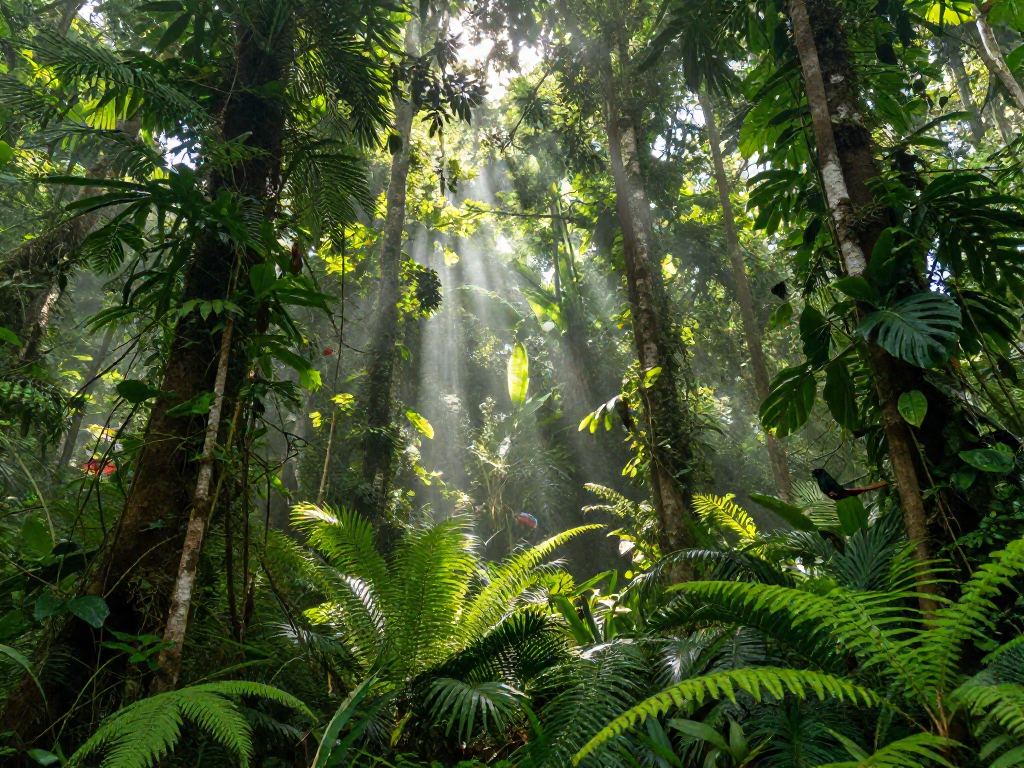
The Short Answer: Why Rainforests Burst With Life
Here's a fact that sounds made up: rainforests cover only about 6% of Earth's land surface, yet they're home to more than half of all the planet's plant and animal species. Squeeze the world's wildlife into a map, and most of it crowds into these steamy green strips near the equator.
So why does so much life pile into such a small space? It comes down to three big drivers:
- A warm, stable climate. Temperatures stay mild and steady all year, so animals don't waste energy surviving brutal winters or scorching droughts.
- Constant rain. Tropical rainforests can get 80 inches (200 cm) of rain or more annually, fueling nonstop plant growth.
- Year-round food. With something always flowering or fruiting, there's a buffet open in every season.
The chain reaction is simple: more rain and warmth mean more plants, more plants mean more food, and more food means more niches (specific roles or "jobs" an animal can have in its habitat) for creatures to fill. A frog, a beetle, and a monkey can all thrive in the same tree without stepping on each other's toes.
And that crowding has a secret organizing trick: the rainforest is stacked into layers, from the dark forest floor to the sunlit treetops. We'll climb through each one next.
The 4 Layers of the Rainforest (and Who Lives Where)
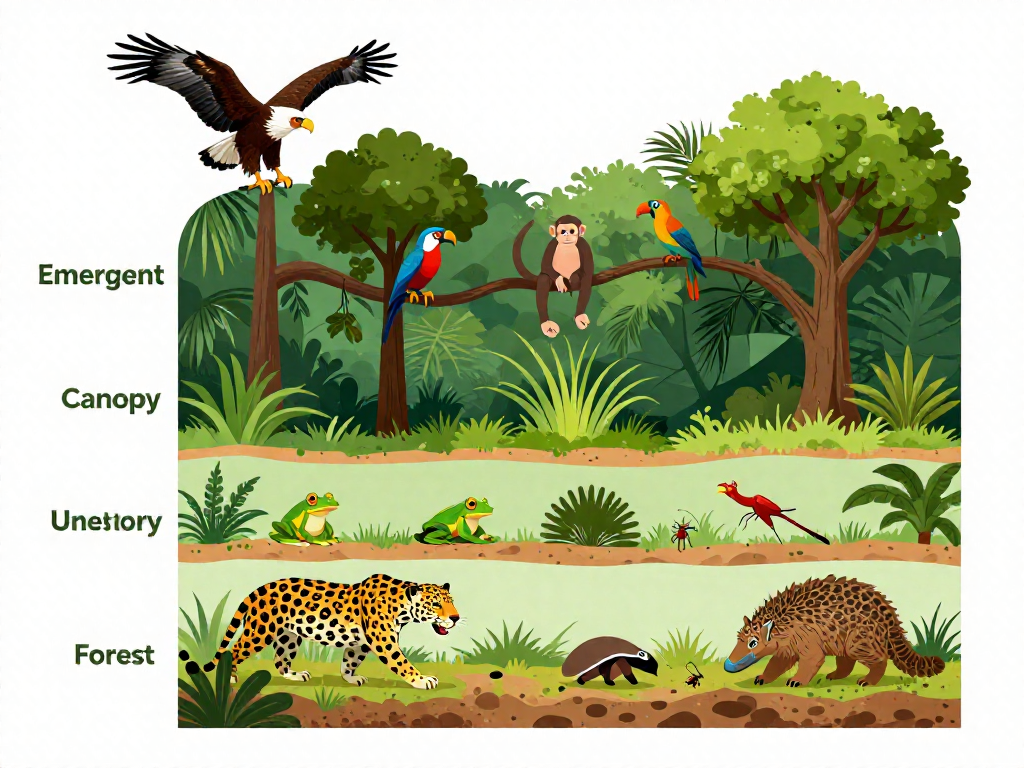
Imagine an apartment building where every floor has completely different neighbors — that's a rainforest. Instead of spreading life out flat, the jungle stacks it vertically into four layers, and each one is its own little world with its own residents, light levels, and rules for survival. This vertical stacking is a big reason one patch of rainforest can shelter more animal species than entire continents elsewhere.
Emergent Layer (the rooftop)
These are the giants — a few towering trees that punch above everything else, sometimes over 200 feet tall (taller than a 15-story building). Up here it's sunny, windy, and exposed. The residents are mostly fliers: harpy eagles (one of the world's most powerful birds of prey), colorful macaws, and bats that cruise above the treetops.
Canopy (the busy main floor)
If the rainforest has a downtown, this is it. The canopy is a dense, sunlit roof of leaves and branches, and scientists estimate the majority of rainforest species live here. It's packed with monkeys swinging between branches, slow-moving sloths, tree frogs, countless insects, and birds feasting on fruit and flowers. So much food and shelter sits in one place that many canopy animals are born, live, and die without ever touching the ground.
Understory (the dim middle)
Below the canopy, sunlight gets blocked, so this layer is shadowy, still, and humid. Plants grow big, broad leaves to grab what little light filters down. It's a great place to hide — which is why you'll find jaguars resting on branches, snakes coiled and waiting, and swarms of insects. Quiet up top often means an ambush hunter below.
Forest Floor (the recycling center)
Only about 2% of sunlight reaches the bottom, so it's dark, damp, and surprisingly bare of plants. But it's far from empty. This is where the cleanup crew works: leaf-cutter ants haul bits of leaves to underground fungus gardens, large mammals like tapirs forage, and decomposers (organisms that break down dead material) turn fallen leaves and animals back into nutrients the whole forest reuses.
The big idea: each layer is basically its own neighborhood — different light, food, and shelter mean different animals can specialize and thrive without crowding each other out. Stack four neighborhoods on top of one another, and you get a staggering amount of life in a single place.
What Biodiversity Actually Means (in Plain English)
Here's a number that sounds made up: a single rainforest tree can host more ant species than live in the entire United Kingdom. That jaw-dropping crowd is biodiversity in action — simply, the variety of living things packed into one place.
So why does the jungle win the variety contest? A few things stack up:
- A steady, gentle climate. Tropical rainforests stay warm and wet all year, so there's no brutal winter or dry season to wipe species out. Life can keep going nonstop, and animals that would freeze or starve elsewhere thrive here.
- Super-specific jobs (specialization). With so much stability, animals can afford to evolve for tiny, exact roles. Some poison dart frogs raise their tadpoles in the little pools of water that collect inside a single plant's leaves — that's their entire nursery.
- Competition that splits the crowd. When lots of species want the same food or space, overlapping too much means losing. So instead of fighting head-on, animals carve out their own niche (a species' specific role and lifestyle). One bird feeds at dawn high in the canopy; another feeds at dusk near the ground.
Put it together and the rainforest becomes a giant, well-organized neighborhood where almost every nook has a specialist living in it. That's how a forest can shelter thousands of species side by side — each one quietly doing a job no one else does quite the same way.
Standout Rainforest Animals You Should Know
Some rainforest animals are so strange they sound made up — like a mammal that grows its own garden. Meet a few residents you'll never forget.
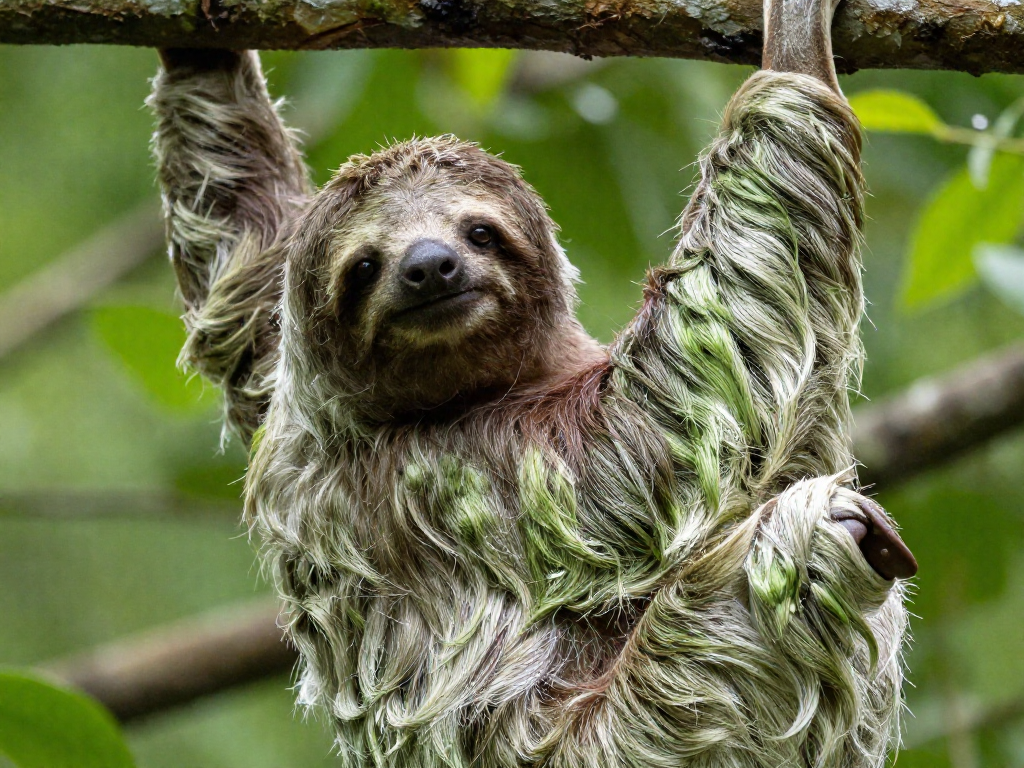
The Sloth: A Walking Ecosystem
Sloths move so slowly that algae actually grows in their fur, giving them a greenish tint that doubles as camouflage. That mini-ecosystem hosts moths, beetles, and other tiny organisms — a whole community living on one animal. Their slow pace isn't laziness; it's an energy-saving strategy that lets them survive on a low-calorie diet of leaves.
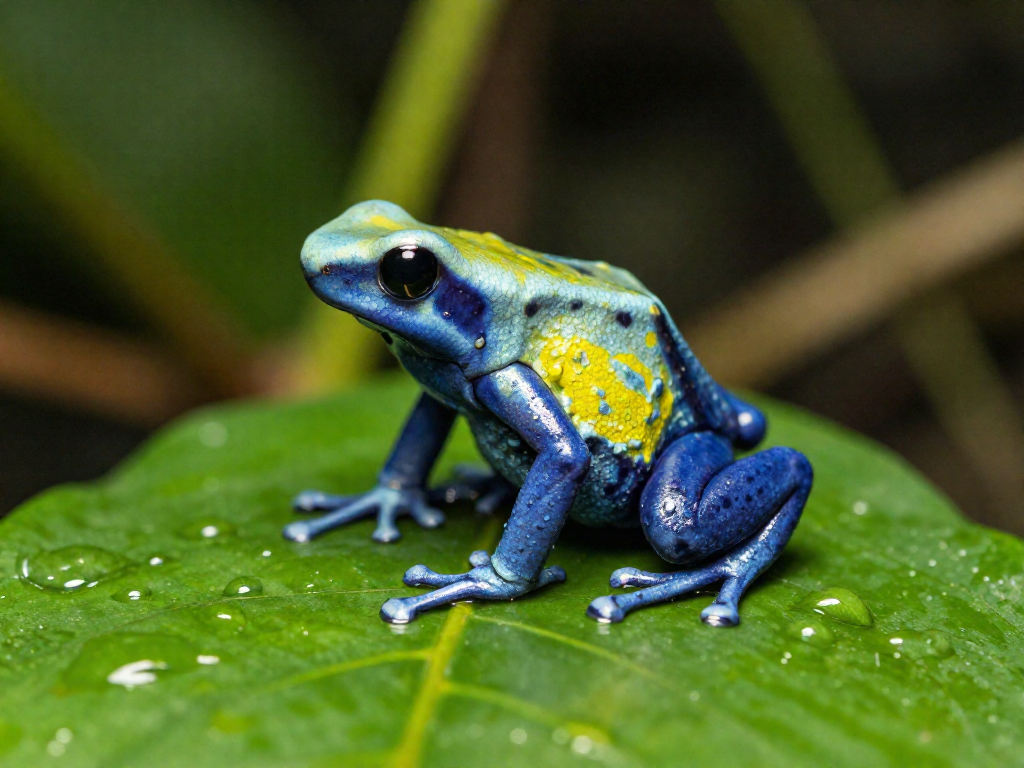
Poison Dart Frogs: Bright Means "Back Off"
These thumbnail-sized frogs wear electric blues, yellows, and oranges for a reason. The bold colors are aposematism (a warning signal to predators), advertising that the frog is toxic. Interestingly, many get their poison from the insects they eat in the wild — frogs raised in captivity on a different diet often aren't toxic at all.
Harpy Eagle: Talons Like a Bear's Claws
One of the most powerful raptors on Earth, the harpy eagle has rear talons that can reach around 5 inches (13 cm) long — comparable to a grizzly bear's claws. It uses that grip to snatch monkeys and sloths straight out of the canopy.
Leaf-Cutter Ants: Underground Farmers
You may have seen them marching with leaf fragments held overhead, but they don't actually eat the leaves. They carry them into underground chambers to grow a special fungus, which becomes their food. That makes leaf-cutter ants true farmers — a behavior they perfected long before humans tried it.
Quick Hits
- Glass frogs: Their translucent belly skin lets you see their heart and organs working underneath.
- Jaguars: They have one of the strongest bites of any big cat and aren't afraid to swim.
- Toucans: That oversized, colorful bill is surprisingly lightweight and helps the bird shed body heat.
From living gardens to insect farmers, the rainforest proves that "weird" is often just nature's word for brilliantly adapted.
How Rainforest Animals Survive: Clever Adaptations
A sloth can grow algae in its own fur, turning itself green to blend into the canopy. That's just one of the wild tricks rainforest animals use to survive in one of the most crowded neighborhoods on Earth. With so many species packed together, staying alive often comes down to being clever.
Hiding (and bluffing) in plain sight. Many animals rely on camouflage to disappear, while others use mimicry (copying a more dangerous animal) to scare off predators. Some caterpillars, for example, puff up to resemble small snakes—a fake-out that buys them time.
Going up to stay safe. Ground level is a risky place to live, so countless animals move into the treetops. Monkeys, sloths, tree frogs, and many birds spend nearly their whole lives in the canopy, far from ground-based hunters.
Eating without elbowing. When thousands of species share one forest, competition for food is fierce. Animals get around this by specializing. Toucans crack large fruits, hummingbirds sip nectar, and anteaters stick to insects—so each species fills its own niche (its specific role and food source) instead of fighting over the same meal.
Colors that talk. Bright colors send messages. The strawberry poison dart frog's vivid red warns predators "I'm toxic—don't eat me," a strategy called aposematism (warning coloration). Other animals use flashy colors for the opposite reason: to attract a mate.
Together, these adaptations let an astonishing number of animals share the same lush home without crowding each other out.
Why It Matters: Rainforests Are Worth Protecting
Here's a thought that's easy to miss: many rainforest animals live nowhere else on the planet. The golden lion tamarin clings to a sliver of Brazil's Atlantic Forest, and countless frogs, insects, and birds are endemic (found in one place and nowhere else). If their patch of forest disappears, so do they.
And the forests are shrinking. According to the World Wildlife Fund, tropical forests are still being cleared for farming, logging, and roads, squeezing this concentrated burst of life into smaller and smaller pockets.
The good news? Caring starts with curiosity. The more we understand and talk about these animals, the more support conservation gets. Small steps add up:
- Choose products with credible certifications, like FSC-labeled wood and paper.
- Support reputable rainforest and wildlife organizations.
- Share what you learn—wonder is contagious, and it fuels protection.
Knowing why so much life lives in the jungle is the first step to helping it stay there.
FAQ
Why do rainforests have so many animal species?
Rainforests pack in so much life because they offer warmth, steady moisture, and food year-round—ideal conditions for living things to thrive and diversify. The constant climate (no harsh winters to survive) means plants grow nonstop, creating an endless buffet and countless places to live, from the soil to the treetops. That huge variety of habitats, or "niches" (specific roles and spaces a species occupies), lets thousands of animals coexist without all competing for the same meal. Add millions of years of stable conditions for new species to evolve, and you get the richest biodiversity on Earth.
What is the most biodiverse layer of the rainforest?
The canopy—the dense roof of branches and leaves about 60–130 feet up—is the busiest, most biodiverse layer, often estimated to hold the majority of rainforest species. It soaks up the most sunlight, so it bursts with fruit, flowers, and leaves that feed insects, birds, monkeys, sloths, and tree frogs. Many of these animals are born, eat, and die without ever touching the ground. Scientists sometimes call it a hidden world, because so many canopy species are still being discovered.
How many animal species live in rainforests?
No one knows the exact number, but rainforests are thought to be home to more than half of the world's land animal and plant species—despite covering only about 6% of Earth's land surface. The Amazon alone hosts an estimated 2.5 million insect species, plus thousands of birds, mammals, reptiles, amphibians, and fish. Researchers regularly describe new species, so the total keeps climbing. The honest answer is that we're still counting, and likely will be for a long time.
What is the most dangerous animal in the rainforest?
If "dangerous" means deadliest to humans, the answer is surprisingly small: the mosquito, which spreads diseases like malaria and dengue and causes more human deaths worldwide than any large predator. Among the more dramatic residents, jaguars, venomous snakes such as the fer-de-lance, and poison dart frogs (whose skin toxins protect them from predators) all earn respect. But most rainforest animals avoid people and only pose a risk if cornered or handled. Always observe wildlife from a distance and follow guidance from local experts and wildlife authorities.
Do all rainforests have the same animals?
No—rainforests on different continents are home to completely different casts of animals, even when the species look or act alike. Jaguars prowl the Amazon in South America, while tigers and orangutans live in Southeast Asia, and gorillas and okapis roam Africa's Congo Basin. This happens because these forests have been separated by oceans for millions of years, so life evolved independently in each one. The result is similar jungle "jobs" filled by totally unrelated animals—a phenomenon biologists love to point out.
See also
- Amazing Animal Facts category page
- Why Sloths Move So Slowly explainer
- How Poison Dart Frogs Make Their Toxins
- Animals That Live in the Amazon Rainforest list post
- What Is Camouflage and How Do Animals Use It
Related articles
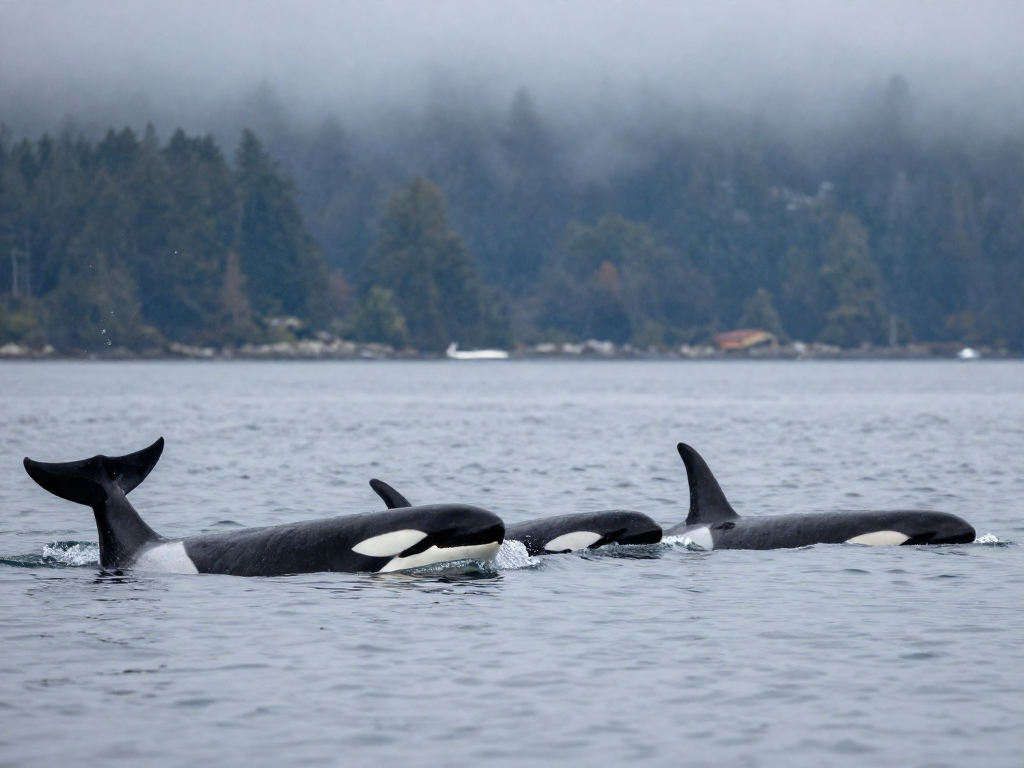
My Unpopular Opinion: Stop Calling Them 'Killer' Whales
Why should we stop using the term 'killer whale'?
Jul 28, 2026 · 3 min read
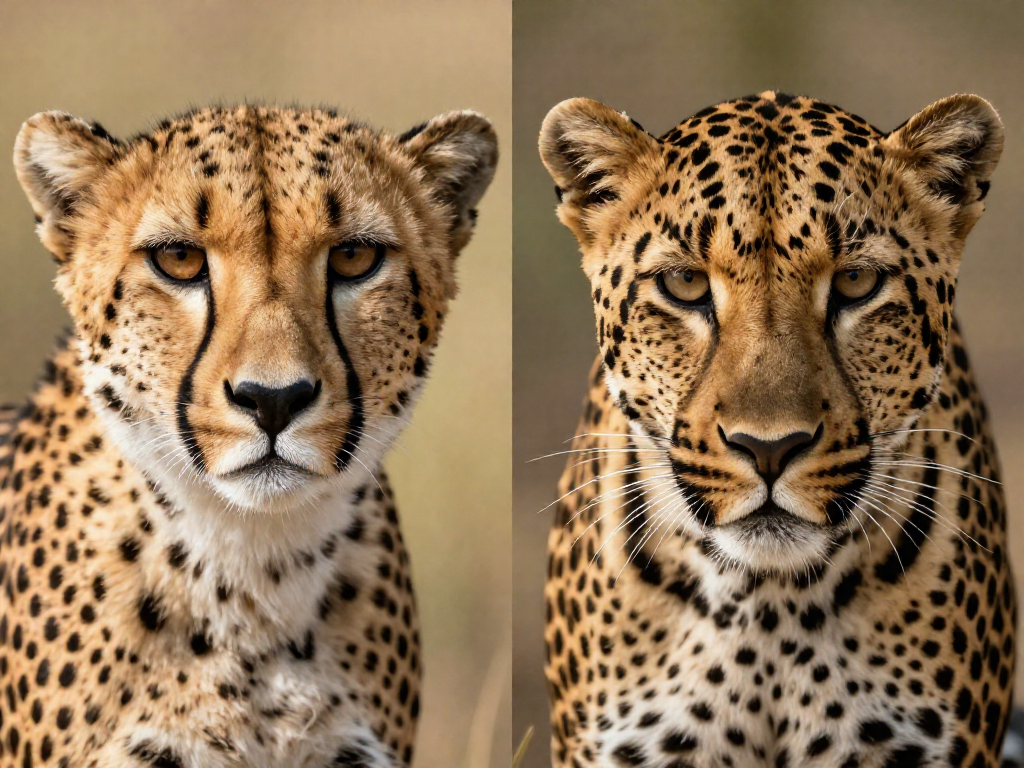
Cheetah vs. Leopard: Spotting the Difference in the Wild
How can you tell the difference between a cheetah and a leopard? Learn the key features including tear marks, spots, body shape, hunting styles, and sounds—all in one easy guide.
Jul 28, 2026 · 6 min read
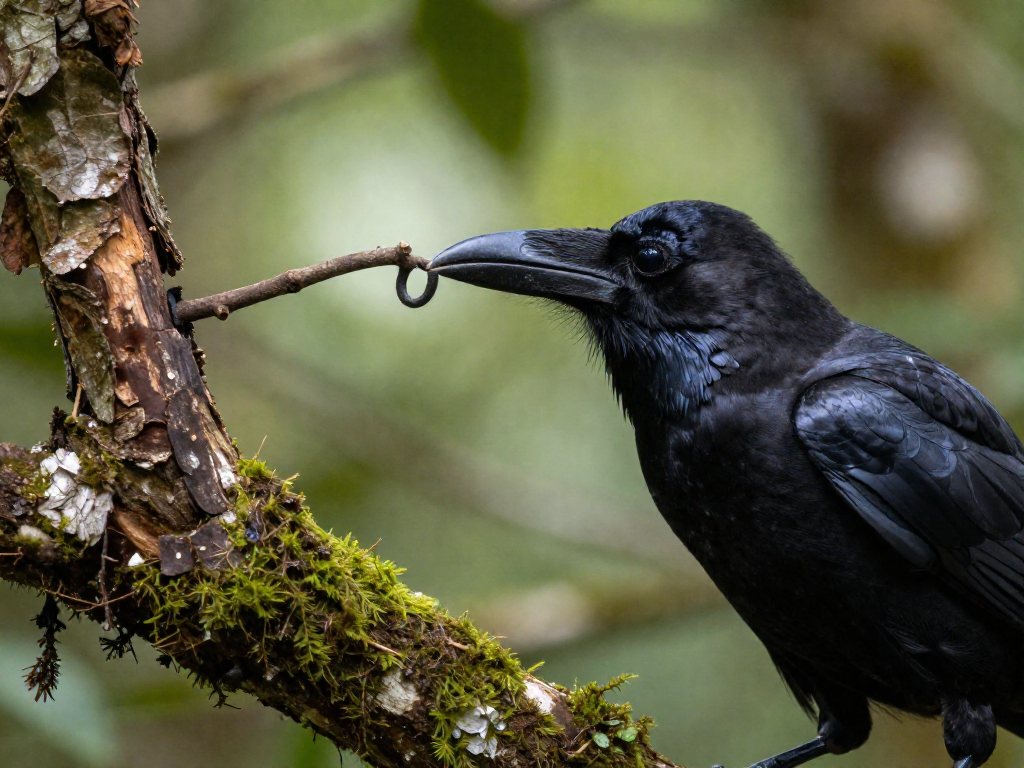
8 Animals That Use Tools (And What They Do with Them)
Which animals use tools, and how do they use them? From crows bending wires to octopuses carrying coconuts, discover 8 tool-using animals.
Jul 28, 2026 · 6 min read