Why Do Bees Die After They Sting? The Science Behind a Selfless Sacrifice
Why do bees die after they sting?
On this page
If you think all bees die after stinging, think again—only honeybees make this ultimate sacrifice, and the reason is a fascinating evolutionary twist that leaves their stinger embedded in you, pumping venom even after they’re gone.
Introduction: Not Just Another Bee Sting
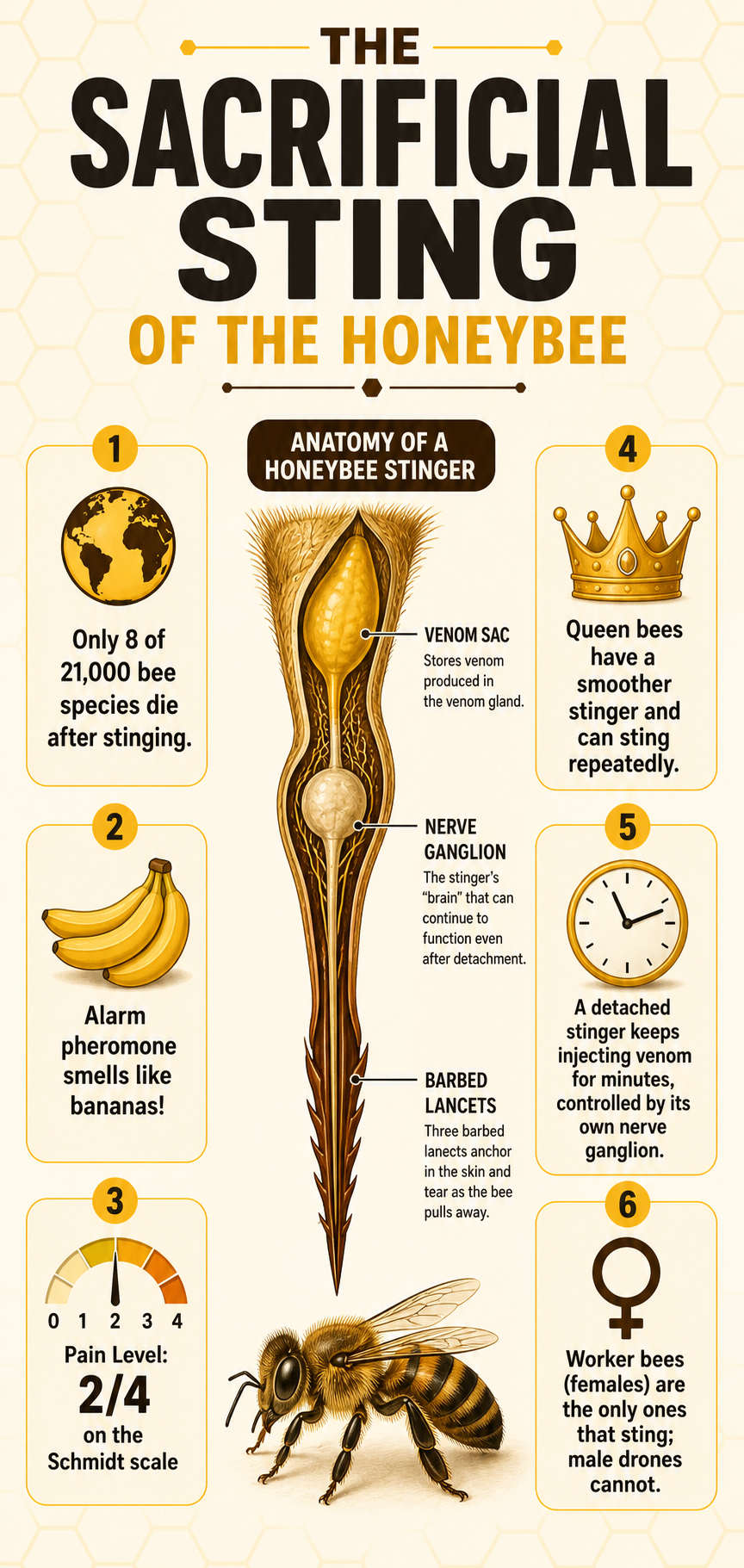
The common assumption that bees die after stinging is almost entirely wrong. Only eight out of nearly 21,000 bee species actually do—a mere 0.04% (University of Wollongong). The one you know best, the European honeybee, is the tragic exception. Its barbed stinger turns a simple defense into a one-way ticket, and the science behind it is both intricate and surprisingly purposeful.
The Sting Mechanism: A Barbed Spear
A honeybee worker’s stinger is a modified ovipositor—a tube originally designed for laying eggs—that evolution has sharpened into a defensive weapon. It’s made of two separate barbed lancets that slide against each other in an alternating, sawing motion, working deeper into whatever they pierce.
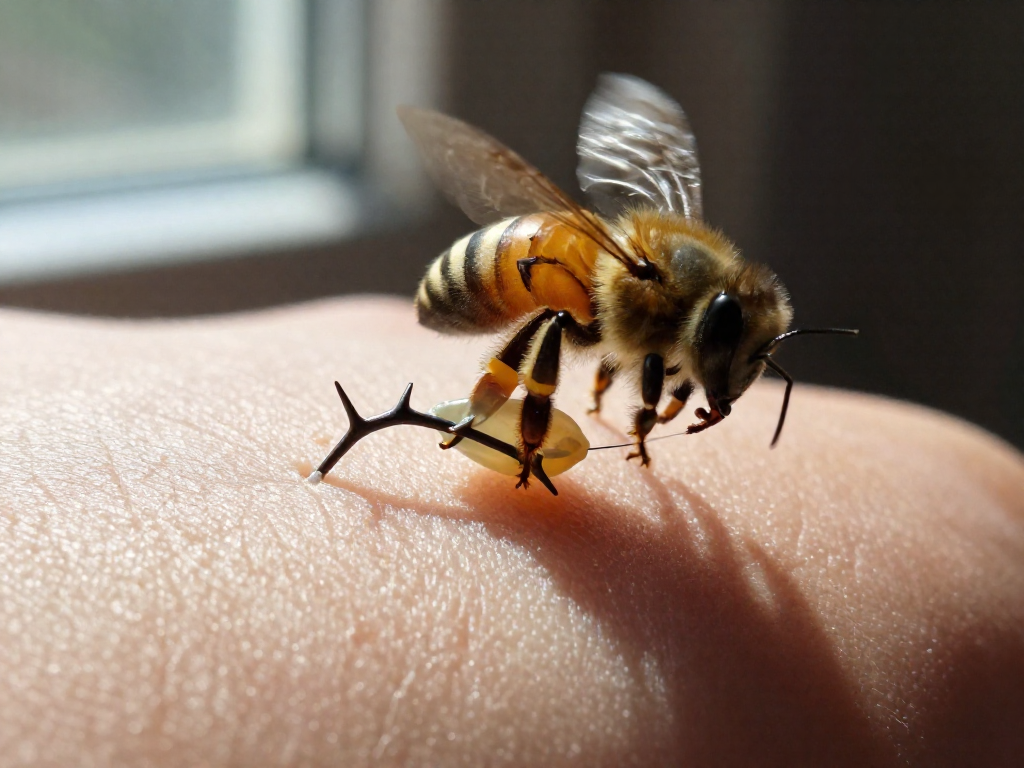
Once the stinger punctures skin, those barbs act like a screw anchor. As Mark Winston explained to PBS News, the blades “scissoring together into your flesh,” making it impossible for the bee to simply pull out. When she tries to fly away, the stinger stays put, and the bee rips part of her own abdomen free—leaving behind not just the stinger, but the venom sac, muscles, and a small nerve ganglion.
That nerve ganglion is the key to what happens next. Even fully detached, the stinger continues pumping venom. A valve system replaces muscular compression, and the ganglion keeps the barbs sawing rhythmically, driving venom deeper for up to a minute or more (UC Riverside). This gruesome self-amputation is unique to worker honeybees; queen bees have smoother stingers they can use multiple times, and drones don’t sting at all.
The design is ancient: stinging insects have been using modified ovipositors in self-defense for around 190 million years. But it’s the honeybee worker’s barbed innovation that turns a simple sting into a final, self-sacrificing act.
Why It’s Fatal: Self-Amputation and Aftermath
When a honeybee worker stings a mammal with elastic skin, she can’t simply pull out. Her barbed stinger anchors like a screw anchor, and as she tries to fly away, her lower abdomen ruptures. She tears herself apart, leaving behind a gaping wound and a string of tissues—the venom sac, muscles, glands, and even digestive material.
The abandoned stinger isn’t dead; it comes with its own nerve ganglion and a valve system that keep it pumping venom. The two rows of saw-toothed lancets scissor deeper and deeper into the skin, all without the bee attached. As UC Riverside’s bee researchers detail, muscular movements coordinated by that detached nerve knot drive the stylets alternately, so venom delivery continues long after the bee is gone.
Back at the hive, the worker doesn’t die instantly. She may survive anywhere from 18 to 114 hours, still able to defend the colony even with that catastrophic injury. But the hole in her abdomen is fatal; she won’t recover.
A Common Mistake: Most Bees Don’t Die
When you hear “bees die after stinging,” you’re really only talking about one tiny group. As researchers at the University of Wollongong point out, only 8 of the nearly 21,000 bee species on Earth die after stinging. That’s less than 0.04% of all bees—mostly the female worker honeybees we’re familiar with.
The vast majority of bees, from fuzzy bumblebees to solitary carpenter bees, have smooth stingers and can sting again and again without harm. Even among honeybees, the rule isn’t universal. Queen honeybees have smoother, less-barbed stingers and use them to battle rival queens—surviving the encounter just fine. Male drone bees, meanwhile, don’t even have a stinger. And hundreds of bee species have lost the ability to sting altogether. The suicidal defender is the exception, not the rule.
Selflessness with a Purpose: The Ultimate Sacrifice
A worker honeybee never lays eggs of her own—she’s completely sterile. Her genes pass on only through the queen’s offspring, so protecting the colony is protecting her family. That’s what makes a suicidal sting an act of genetic self-interest, known as kin selection. When she stings, she also releases a banana-scented alarm pheromone (PBS News) that recruits hive mates to defend the nest. Honeybees evolved this extreme defense because they have a large, permanent nest packed with honey and larvae—a treasure worth dying for.
Final Buzz: Quick Takeaways
- Only female worker honeybees die after stinging.
- Their barbed stingers lodge in skin, causing fatal self-amputation.
- A detached stinger pumps venom for minutes — remove it fast.
- The alarm pheromone smells like bananas (PBS News).
- Nearly all other bees can sting again (or can't sting at all).
Sources
- Why do honeybees die when they sting? | PBS News — pbs.org
- 2024 | Most bees don’t die after stinging - and other surprising bee facts - University of Wollongong – UOW — uow.edu.au
- Bee Sting Removal | Bees — bees.ucr.edu
- Bee Stings: Causes, Treatment and Tips on How to Prevent Them - The Best Bees Company — bestbees.com
- Functional anatomy of the worker honeybee stinger (Apis mellifera) — pmc.ncbi.nlm.nih.gov
See also
- How Do Bees Make Honey?
- The Waggle Dance: How Bees Communicate
- Why Are Bees Important for Pollination?
Related articles

Why Do Cats Always Land on Their Feet? The Physics of Feline Righting
Discover the real reason cats land on their feet—it’s not the tail or magic. Learn the step-by-step righting reflex, the surprising physics behind the twist, and why higher falls can sometimes be safer.
Jul 28, 2026 · 4 min read

Why Do Fireflies Glow? And Other Summer Night Questions
Discover the simple science behind firefly bioluminescence, their coded flash language, and family-friendly tips for enjoying these magical insects without harm.
Jul 20, 2026 · 6 min read
Quick Reference: Common Animal Tracks to Spot in Your Backyard
What animal tracks might you find near your home, and how do you identify them?
Jul 20, 2026 · 4 min read