Quick Reference: Common Animal Tracks to Spot in Your Backyard
What animal tracks might you find near your home, and how do you identify them?
On this page
Your backyard is a highway for secret visitors. With a few simple tricks, you can read the stories written in mud and snow.
Why Your Backyard Is Full of Secrets
Your backyard is a secret highway for wildlife long after you’ve gone inside. Trails left in mud, soft soil, sand, or snow reveal the neighbors you rarely see—raccoons, foxes, rabbits, and more. For the clearest views, step outside early in the morning or late in the day when low-angled shadows make every print pop (The Old Farmer’s Almanac).
The 4 Gait Patterns Every Backyard Tracker Should Know
Before you get caught up in individual toes and pad shapes, zoom out and look at the pattern. The way a trail is laid out — the gait — often narrows the suspect list down to a family faster than a perfect print ever could. There are four basic movement signatures you’ll see in a backyard.
Perfect walkers, like deer, foxes, coyotes, and bobcats, are energy misers. They place the rear foot precisely in the print of the front foot, leaving a telltale zigzag trail. A waddler’s track is messier: raccoons, skunks, and woodchucks move one side of the body at a time, so the rear foot doesn’t land in the front print. Instead, you get a cluster of four distinct impressions. Bounders such as weasels and otters leap forward, planting their hind feet exactly where the front feet just were — the track appears as two paws side-by-side, a hallmark of mustelids (Greenbelly). Hoppers (rabbits, squirrels, chipmunks) land front-feet first, then the larger hind feet reach ahead, creating a rectangular group of four prints.
Toe counts sharpen the ID further. Both canines and felines show four toes on front and hind feet, but rodents like squirrels and chipmunks have four toes in front and five in back. If you spot claw marks, you’re likely looking at a canine; cats usually retract their claws and leave a clean imprint. By matching the gait to the toe pattern, you can often name the visitor without ever seeing a textbook track.
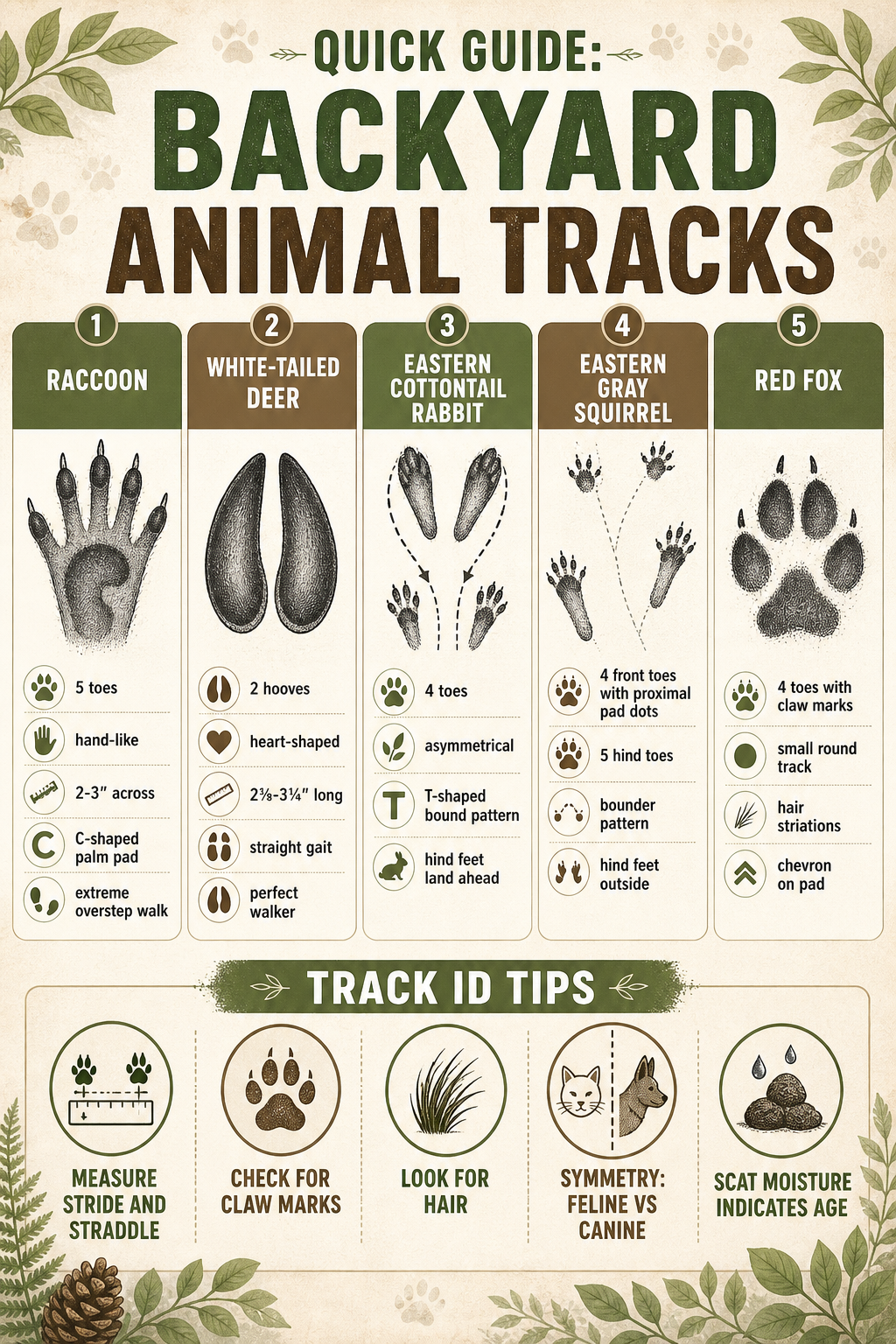
5 Common Backyard Animals and Their Telltale Tracks
Spotting tracks is like reading a story written in mud. These five familiar neighbors leave unmistakable signatures—once you know what to look for.
Raccoon
Look for tiny handprints. The front foot (about 2¼ inches long) has five long, finger-like digits, while the rear foot (3⅛ inches) shows a larger, C-shaped palm pad. Tracks often appear paired—left hind beside right fore—creating a waddling, two-at-a-time trail.
White-tailed Deer
A clean, heart-shaped hoof print is the giveaway. Each track measures 2½–3¼ inches; fawns leave distinctly smaller marks (around 1½ inches). They walk with a straight, perfect walker pattern, registering hind tracks nearly on top of fore tracks.
Eastern Cottontail
Bounding bunnies leave a classic pattern: groups of four prints arranged as a tall, thin rectangle. The larger hind feet angle outward and land ahead of the smaller front feet. The track often shows fur imprints—a soft halo around the edges.
Gray Squirrel
Squirrels hop, and their tracks tell the tale. Hind feet (five toes, no proximal pad dots) land outside and ahead of the front feet (four toes, with obvious pad dots). The bounding groups look like a little pair of hands followed by two larger, elongated feet.
Red Fox or Coyote
Both are four-toed and oval, but look closely. Coyote tracks are narrow ovals with delicate claw marks only on the leading toes; dog tracks, for comparison, are rounder with robust claws on all toes. Red fox tracks, on the other hand, are rounder still and covered in fine hair striations. A curved bar (chevron) on the front middle pad is a dead giveaway for red fox—a detail noted by tracker Linda J. Spielman. If you see a round, fuzzy track with that little bar, you’ve got a fox.
Tricky Look-Alikes: Cat vs. Dog & More
Cat vs. dog: cat prints (bobcat or house cat) lack claw marks because cats retract their claws; dog prints usually show them on all four toes. The heel pad’s leading edge reveals more: a dog’s is a single lobe, a cat’s splits into two, and the front two toes don’t line up side by side. (Bear Tracker) Coyote tracks are more oval, toes point forward, nails are sharp, and claw marks often appear only on the two leading toes. A domestic dog’s track is rounder with blunter nails and toes that splay out. For squirrels, front tracks show four toes with tiny heel dots, and the larger hind feet land outside the front. Rabbit tracks form a tall, thin rectangle: the hind feet land together ahead of the fronts, often angled inward, with all four toes similar.
Quick Tips for Tracking Success
Always snap a photo with a coin or ruler for scale—later, you’ll be glad you did. To judge freshness, gently check if any scat is still moist (The Old Farmer’s Almanac). Follow the trail a short distance to see the gait pattern, and keep a field guide or tracking app handy to confirm your finds.
Sources
- Animal Tracks You Can Identify in Your Yard — treehugger.com
- Who Goes There? Identifying Animal Tracks In Your Backyard - The National Wildlife Federation Blog — blog.nwf.org
- 36 Most Common Animal Tracks | Identification Guide for USA – Greenbelly Meals — greenbelly.co
- Animal Track Identification: Animal Footprint I.D. Chart | The Old Farmer's Almanac — almanac.com
- Getting Started Identifying Animal Tracks | NatureTracking — naturetracking.com
- [PDF] Identifying and Preserving Wildlife Tracks - Publications — pubs.nmsu.edu
- What's the difference between coyote and dog tracks — christinedemerchant.com
- Knowing Coyote Tracks — lindajspielman.com
- Canine vs. Feline Tracks - How to tell the difference between them. — bear-tracker.com
- Canine Tracks — pei-untamed.com
See also
- Fascinating Raccoon Facts
- Why Do Squirrels Bury Nuts?
- Backyard Deer Behavior You Might Not Know
- Coyote Safety: What to Do If You See One
Related articles
Why Do Cats Always Land on Their Feet? The Physics of Feline Righting
Discover the real reason cats land on their feet—it’s not the tail or magic. Learn the step-by-step righting reflex, the surprising physics behind the twist, and why higher falls can sometimes be safer.
Jul 28, 2026 · 4 min read

Why Do Fireflies Glow? And Other Summer Night Questions
Discover the simple science behind firefly bioluminescence, their coded flash language, and family-friendly tips for enjoying these magical insects without harm.
Jul 20, 2026 · 6 min read
Why Do Bees Die After They Sting? The Science Behind a Selfless Sacrifice
Discover why only honeybees die after stinging while most bees don’t. The science of barbed stingers, self-amputation, and the surprising banana scent.
Jul 20, 2026 · 4 min read