How Do Whales Hold Their Breath for So Long? The Superpower of Deep Diving
How do whales hold their breath for extended periods?
On this page
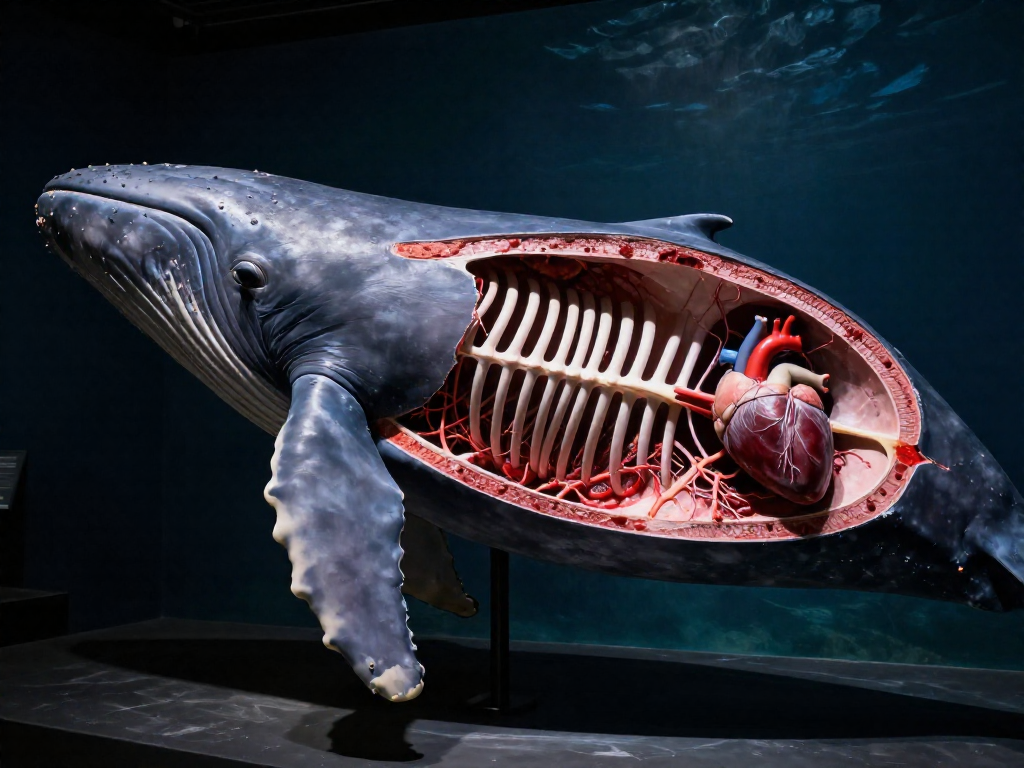
Imagine holding your breath for over three hours while diving nearly two miles deep. That’s the reality for Cuvier’s beaked whales, extreme breath-hold champions. But how do they pull off such an astonishing feat? The secret lies in a suite of physiological superpowers—from oxygen-storing muscles to a heart that slows to a crawl.
The Oxygen Storage Secret: It’s Not Lungs, It’s Muscle
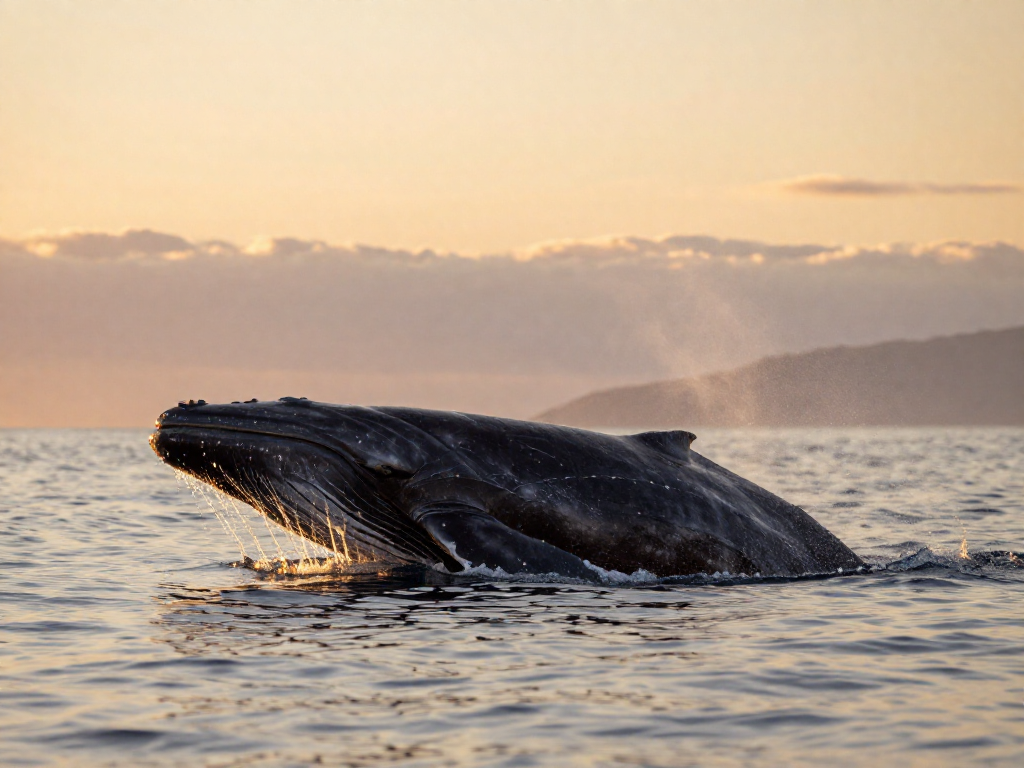
Whales hold their breath not by gulping a giant breath, but by storing a massive reserve of oxygen directly in their muscles. When a whale dives, its lungs collapse under pressure, shunting air away from gas-exchange areas to avoid decompression sickness. The real oxygen stockpile lies in a special muscle protein called myoglobin, which acts like a molecular oxygen battery—releasing O₂ on the spot as muscles work.
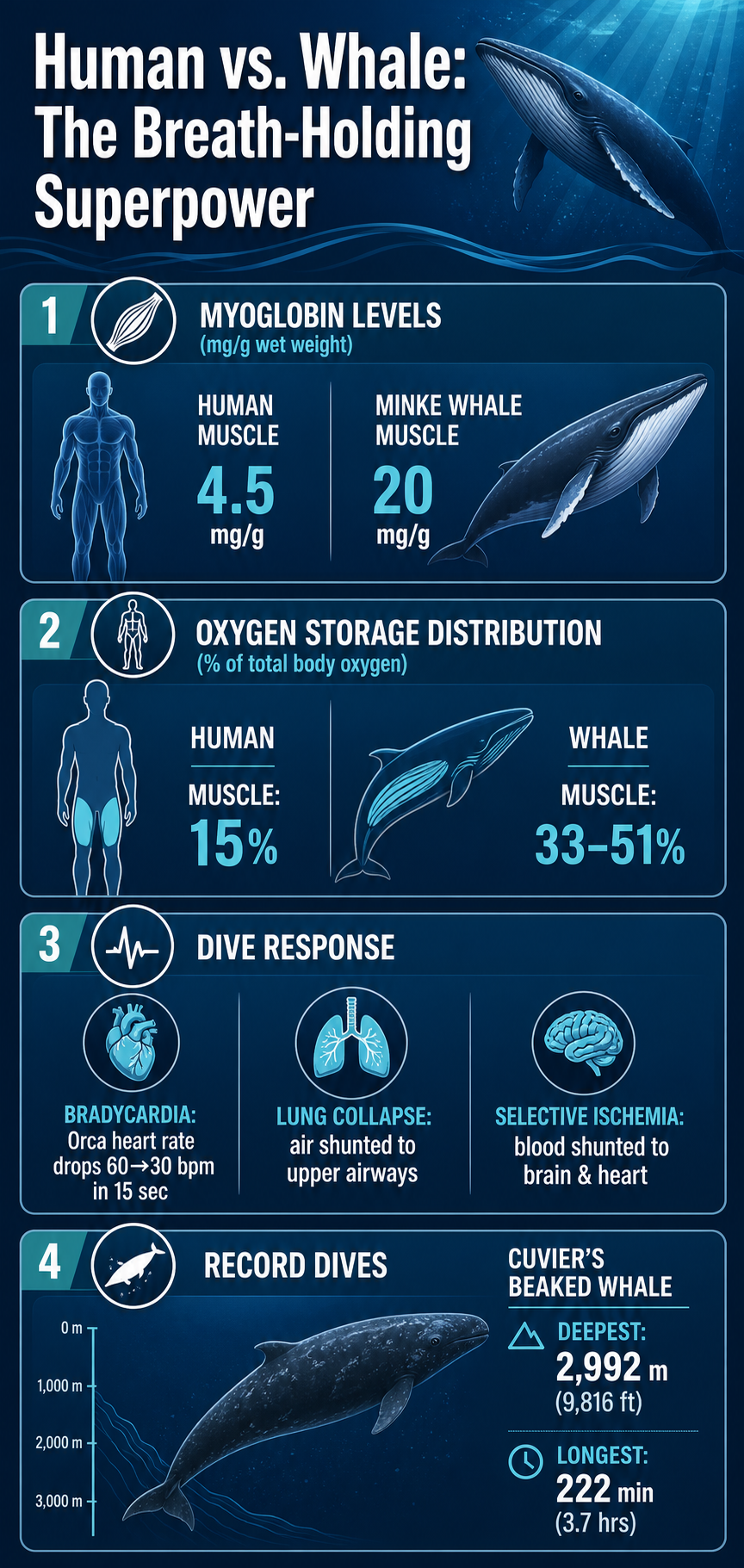
In beluga whales, skeletal muscle holds about 33% of the body’s total oxygen supply; in bottlenose dolphins it’s 38%, and in narwhals it leaps to 51%. For us land mammals, that figure is a mere 15%. A study in Comparative Biochemistry and Physiology Part B found that cetacean muscle myoglobin ranges from 1.81 to 5.78 grams per 100 grams of muscle—far above the typical human concentration (around 0.5 grams per 100g). Among toothed whales, body mass and myoglobin content together explain a whopping 83% of the variation in how long they can stay down.
The distribution isn’t even. Among small cetaceans, the muscles they swim with—the locomotor group—pack a mean myoglobin concentration of 4.58 g per 100g, more than double the 1.96 g in their non-swim muscles. That’s like having hyper-oxygenated fuel tanks right at the engine, ready for demand. In absolute terms, minke whale muscle contains about 20 milligrams of myoglobin per gram, versus roughly 4.5 mg in human slow-twitch fibers.
So when you think of a whale’s breath-holding superpower, don’t picture a huge balloon of air. Picture its swim muscles, saturated with an oxygen reserve that would let it sprint long after a human would pass out.
The Dive Response: Slowing the Heart and Conserving Oxygen
Storing oxygen is only half the secret. The real ingenuity fires the instant a whale submerges. Within seconds, its body throws a switch that would send a human into panic—but for the whale, it’s a superpower.
Heart rate plummets. An orca can halve its heartbeat from 60 to 30 beats per minute in just 15 seconds. But that’s nothing compared to the largest animal on Earth. During a foraging dive, a blue whale’s heart may slow to as few as 2 beats per minute—a rate so sluggish it seems like a typo. A 2019 study in PNAS captured this extreme bradycardia (the scientific term for a dramatic heartbeat slowdown), with surface rates spiking to 37 bpm as the whale gasps for air. That’s a heartbeat range wider than any other creature’s—a toggle between near-standstill and rapid recharge.
This cardiac braking is only part of the dive response. Simultaneously, the whale redirects its blood flow through a process called selective ischemia. Blood vessels constrict everywhere except the brain and heart, shunting oxygen-rich blood to the organs that need it most. Kidneys and liver? They’re temporarily cut off, idling until the whale resurfaces. It’s a ruthless triage that preserves the brain’s function even as the rest of the body goes without.
The whole system works with breathtaking speed—triggered by immersion, not by low oxygen. So the next time you take a deep breath and plunge underwater, remember: your body rebels against the cold and pressure, while a whale’s body just says, 'Go deeper.'
Lung Compression: The Built‑in Safety Against the Bends
Whales don’t get the bends—ever—thanks to a simple, built‑in pressure trick. As a whale descends, the surrounding water pressure climbs fast. That pressure squashes its lungs, forcing the air inside up into the rigid upper airways: the trachea and large bronchi. These tough tubes don’t participate in gas exchange; they’re just passageways. So when the lung’s thin, gas‑absorbing sacs collapse, the remaining air is trapped in a place where nitrogen can’t dissolve into the bloodstream. No nitrogen in the blood means no dangerous gas bubbles on the way back up. It’s that clean: lung compression turns the whale’s respiratory system into a closed highway that nitrogen can’t escape, effectively giving them a permanent, depth‑proof protection. As researchers from the University of Miami’s Shark Research & Conservation Program put it, these upper spaces ‘do not exchange gases with the blood,’ so the bends simply never happen. And by forcing air out of the absorptive zones, the whale also eliminates the risk of decompression sickness at any depth—even after the longest dives.
The Champions: Record‑Breaking Dives of Cuvier’s Beaked Whale
Cuvier’s beaked whale is the undisputed champion of deep diving. In 2020, one individual stayed submerged for 222 minutes—a staggering 3.7 hours. That single breath‑holding marathon, recorded off the California coast, is the longest dive ever documented for any mammal.
These whales don’t just go long; they go unbelievably deep. A 2014 study tracked a Cuvier’s beaked whale plunging to 2,992 meters (9,816 feet), the deepest mammalian dive on record. To put that in perspective, that’s nearly the height of 33 football fields stacked end‑to‑end, and almost a kilometer deeper than the previous record held by elephant seals.
What’s even more astonishing is their routine. A typical deep dive for a Cuvier’s beaked whale plunges to an average depth of 1,401 meters and lasts 67.4 minutes, yet the whale surfaces for less than two minutes before diving again. These extreme stats shattered old records—elephant seals had previously held the deepest (2,388 meters) and longest (120 minutes) titles. As researchers from CW Azores note, the beaked whale’s ability to quickly recover and dive again after such an effort underscores just how finely tuned its physiology is for life in the deep.
Surprising Genetics: Why More Myoglobin Doesn’t Mean More Gene Activity
One might expect that the whale muscle’s massive myoglobin stores come from a super-charged gene promoter—the on-switch that drives protein production. Bizarrely, the opposite is true. When scientists compared the minke whale and human myoglobin gene promoters in muscle cells, the whale version was staggeringly weak: it showed only about 8% of the transcriptional activity, or more than 12-fold less activity than the human promoter. Yet the same whale muscle packs around 20 mg of myoglobin per gram of tissue, compared to a measly 4.5 mg/g in human muscle fibers. That’s more than four times the oxygen-carrying protein with a genetic starter motor that barely hums.
The secret lies after the gene is read: the whale’s myoglobin mRNA molecules are unusually stable and get translated into protein with remarkable efficiency. So the tiny trickle of mRNA is milked for all it’s worth, building up a huge protein reservoir over time. This post-transcriptional wizardry extends to how myoglobin is deployed. In small cetaceans, the hard-working locomotor muscles that power swimming hold 4.58 g per 100 g muscle, while non-locomotor muscles contain just 1.96 g. The distribution isn’t an accident—it’s a fine-tuned system that puts oxygen right where it’s needed most, letting whales outlast their prey without ever taking a breath.
A Symphony of Adaptations
No single trick makes a whale a deep-diving champion—it’s a finely tuned trio. Myoglobin-packed muscles hoard oxygen right where it’s needed most, while a slowed heartbeat and selective blood shunting rush reserves only to the brain and heart. Meanwhile, the lungs collapse under pressure, forcing air into the upper airways where nitrogen can’t enter the blood, neatly sidestepping the bends (Shark Research & Conservation Program). Together, these adaptations turn breath-holding into a profound superpower, letting whales rule the deep.
Sources
- Comparative analysis of the myoglobin gene in whales and humans reveals evolutionary changes in regulatory elements and expression levels — pmc.ncbi.nlm.nih.gov
- Myoglobin Concentration and Oxygen Stores in Different Functional Muscle Groups from Three Small Cetacean Species — pmc.ncbi.nlm.nih.gov
- Body size and skeletal muscle myoglobin of cetaceans: adaptations for maximizing dive duration — sciencedirect.com
- Extreme Breath Holding: Marine Mammal Diving – Shark Research & Conservation Program (SRC) | University of Miami — sharkresearch.earth.miami.edu
- Extreme bradycardia and tachycardia in the world’s largest animal — pnas.org
- Cuvier's beaked whale - Wikipedia — en.wikipedia.org
- The Cuvier's beaked whale is the champion of deep diving - CW Azores — cwazores.com
See also
- How Do Cheetahs Run So Fast? The Science of Speed
- Echolocation: How Bats and Dolphins See with Sound
- The Amazing Eyesight of Birds of Prey
Related articles

How Do Spiders Make Silk? The Chemistry Behind Nature's Strongest Fiber
How do spiders produce silk, and what makes it so strong?
Jul 28, 2026 · 10 min read
How Electric Eels Generate Shocks: A Deep Dive into Nature’s Living Batteries
How do electric eels produce electricity?
Jul 28, 2026 · 10 min read

Why Don't Woodpeckers Get Headaches? The Built-In Shock Absorbers
How do woodpeckers avoid brain injury despite repeated hammering?
Jul 20, 2026 · 6 min read